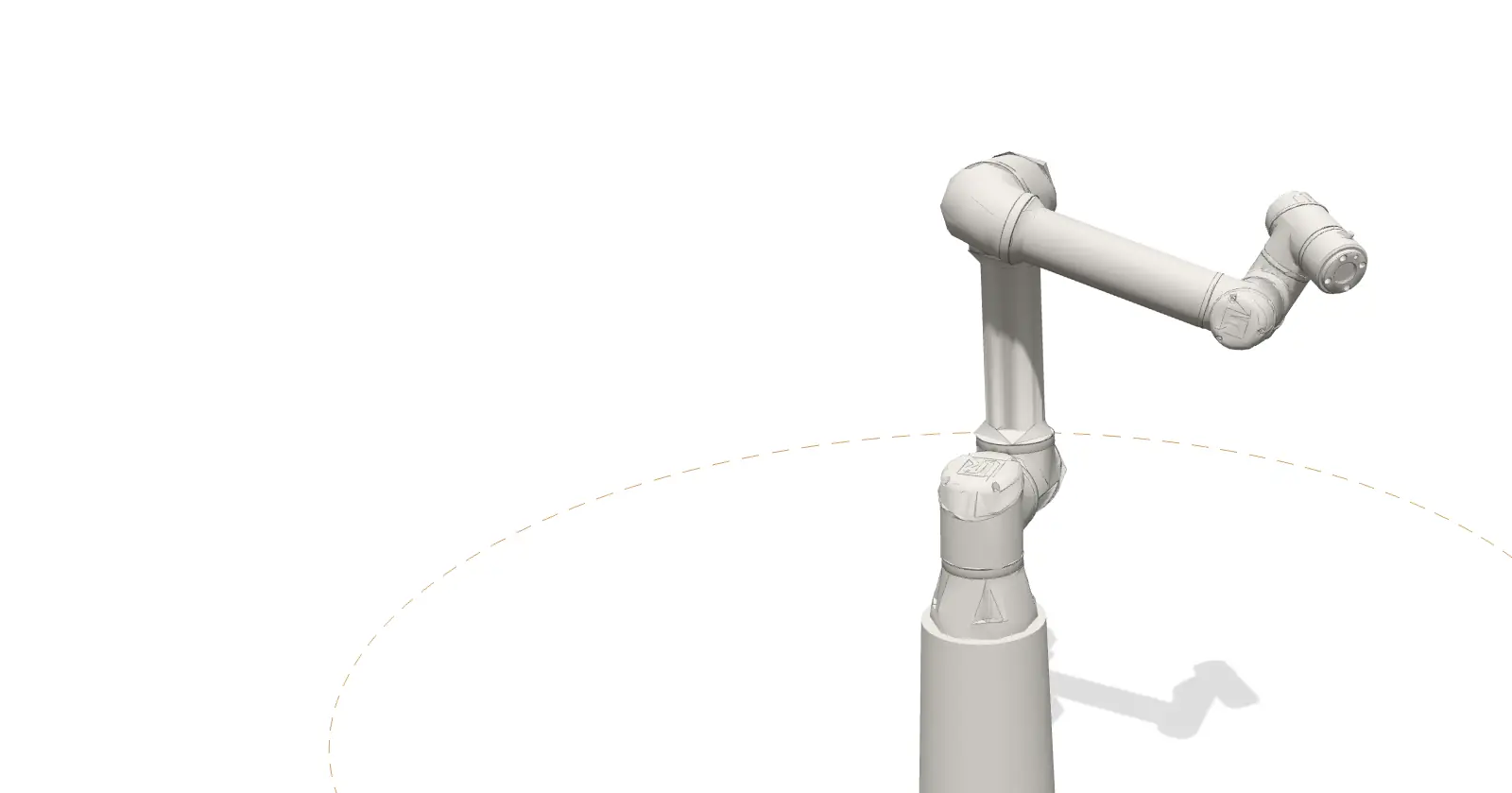
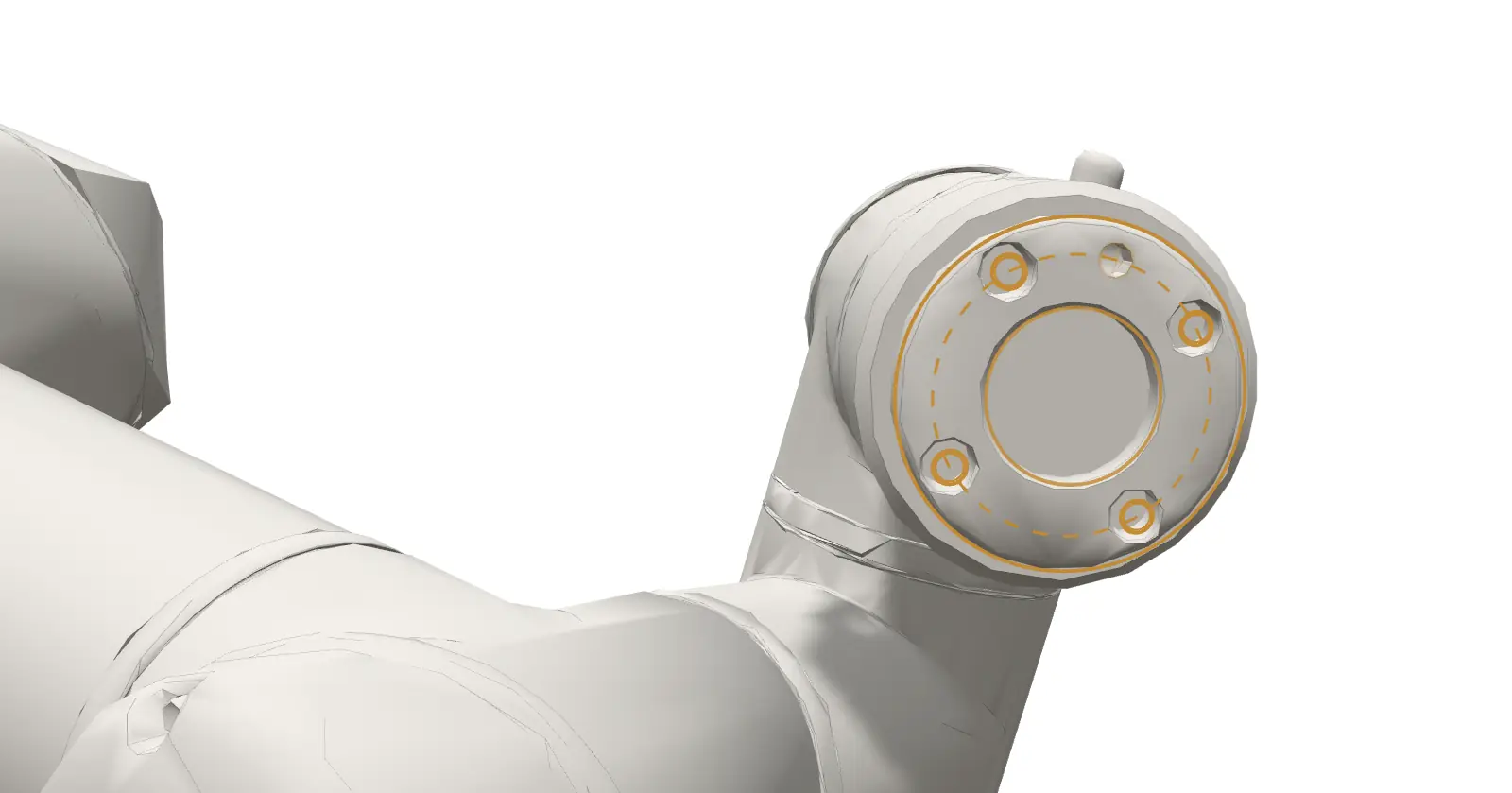
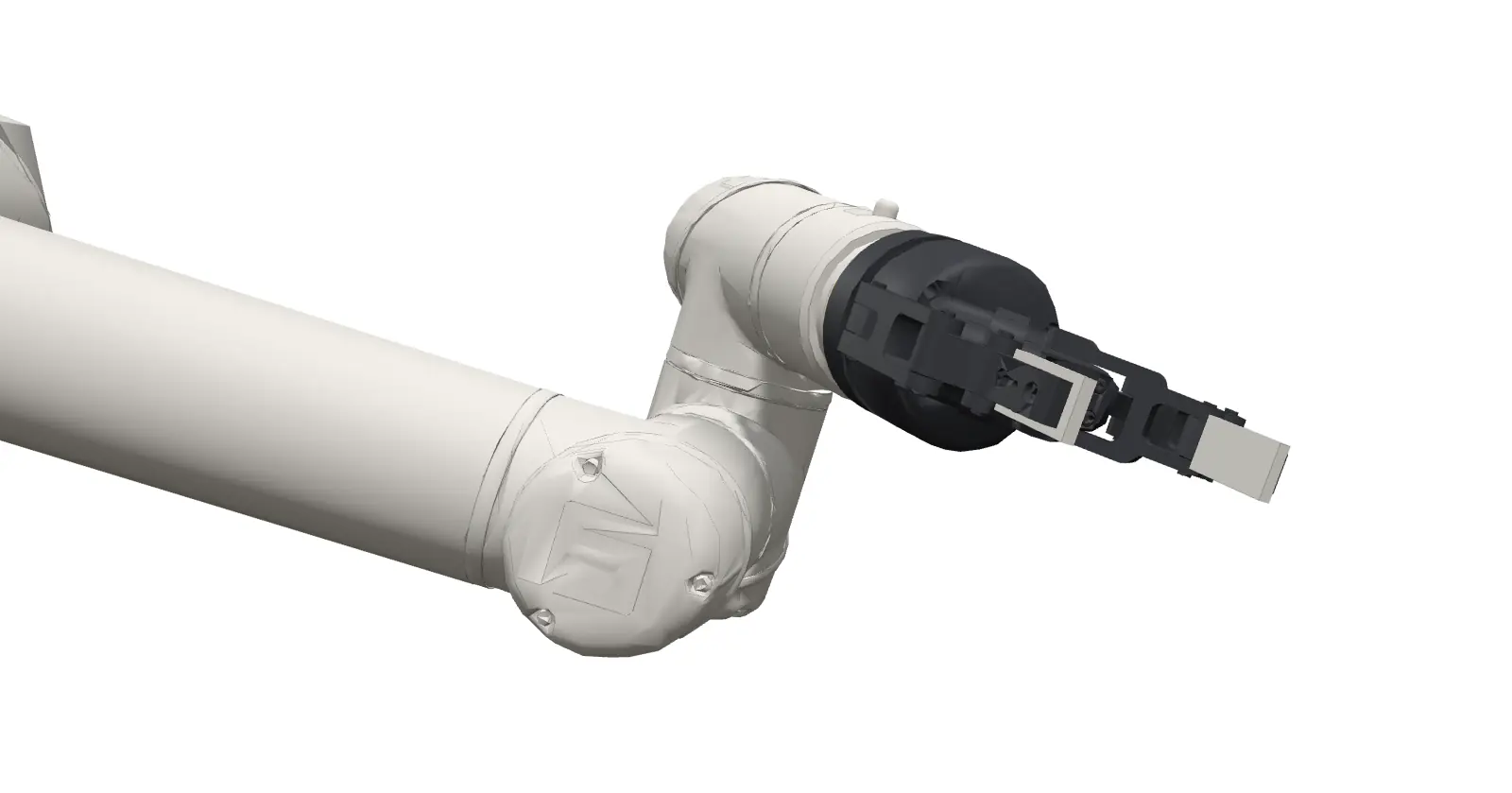
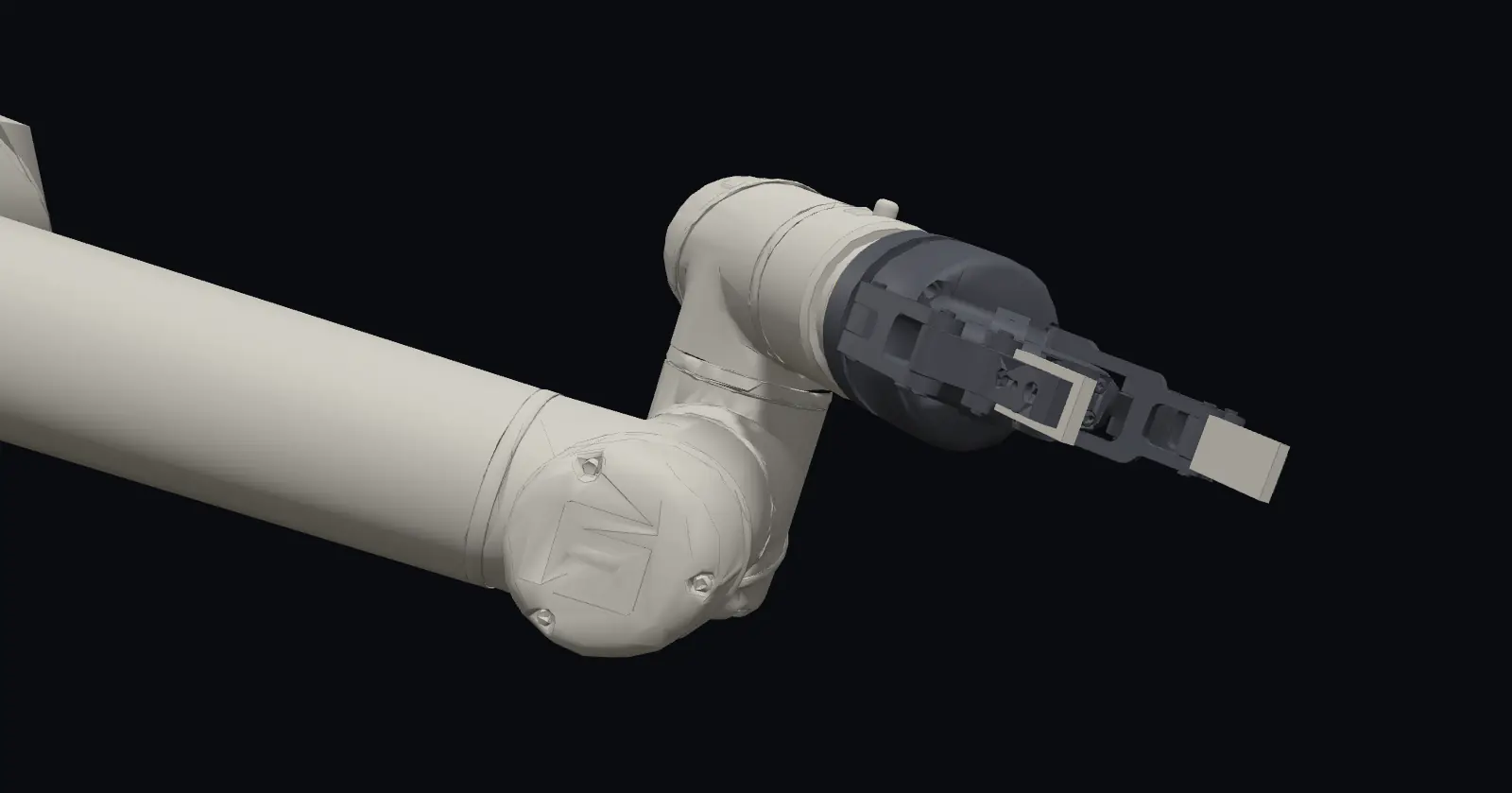
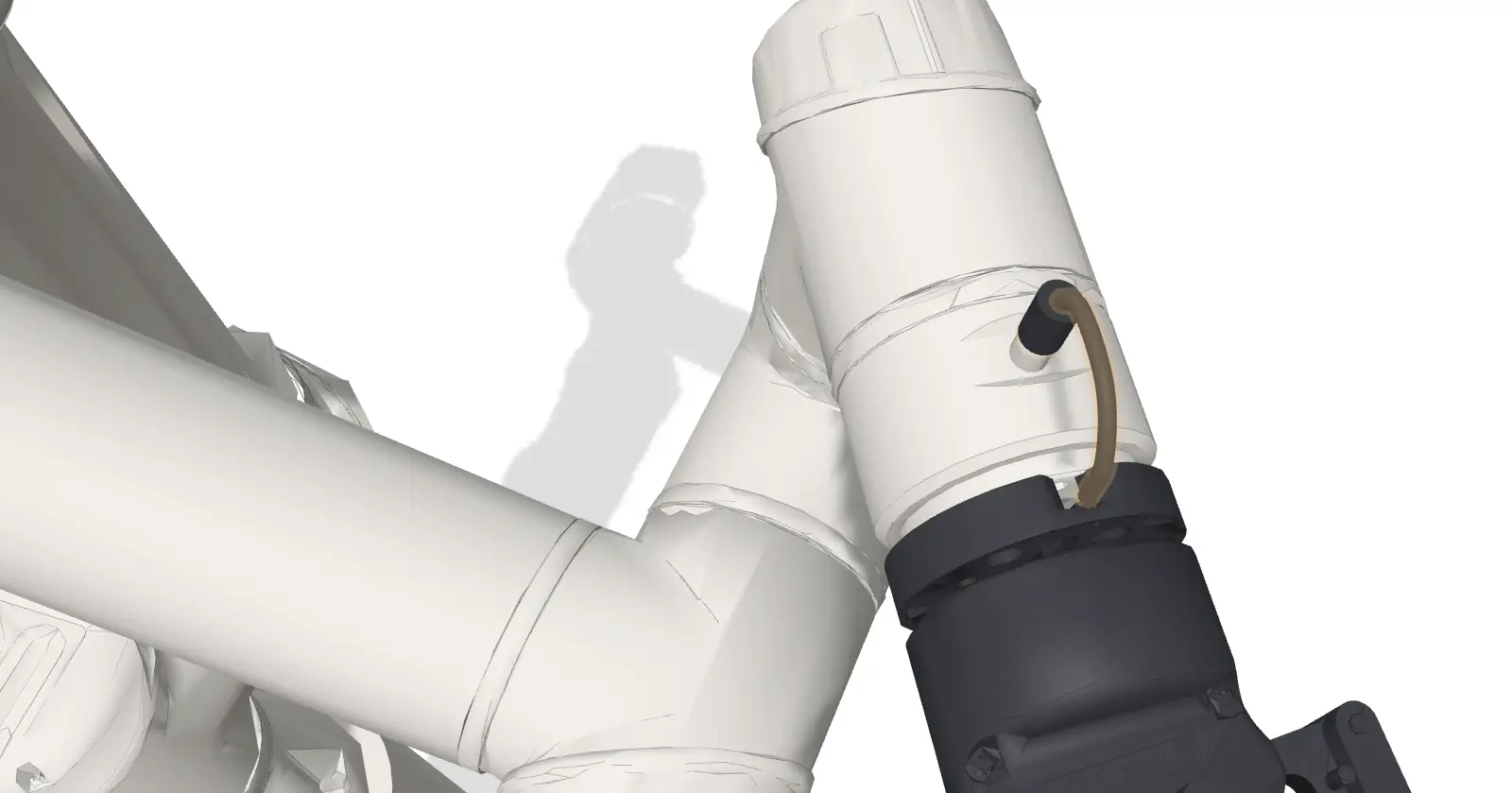
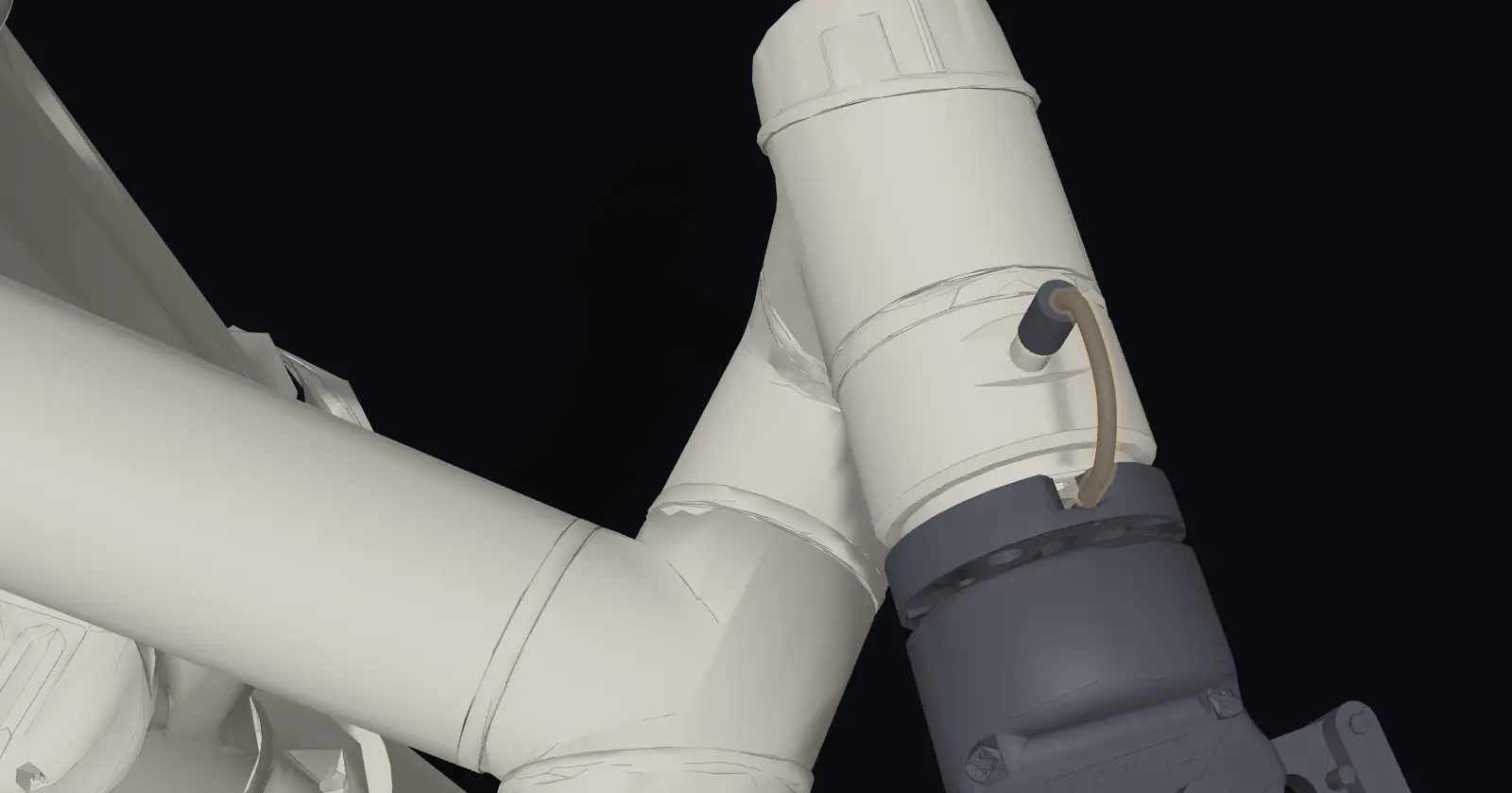
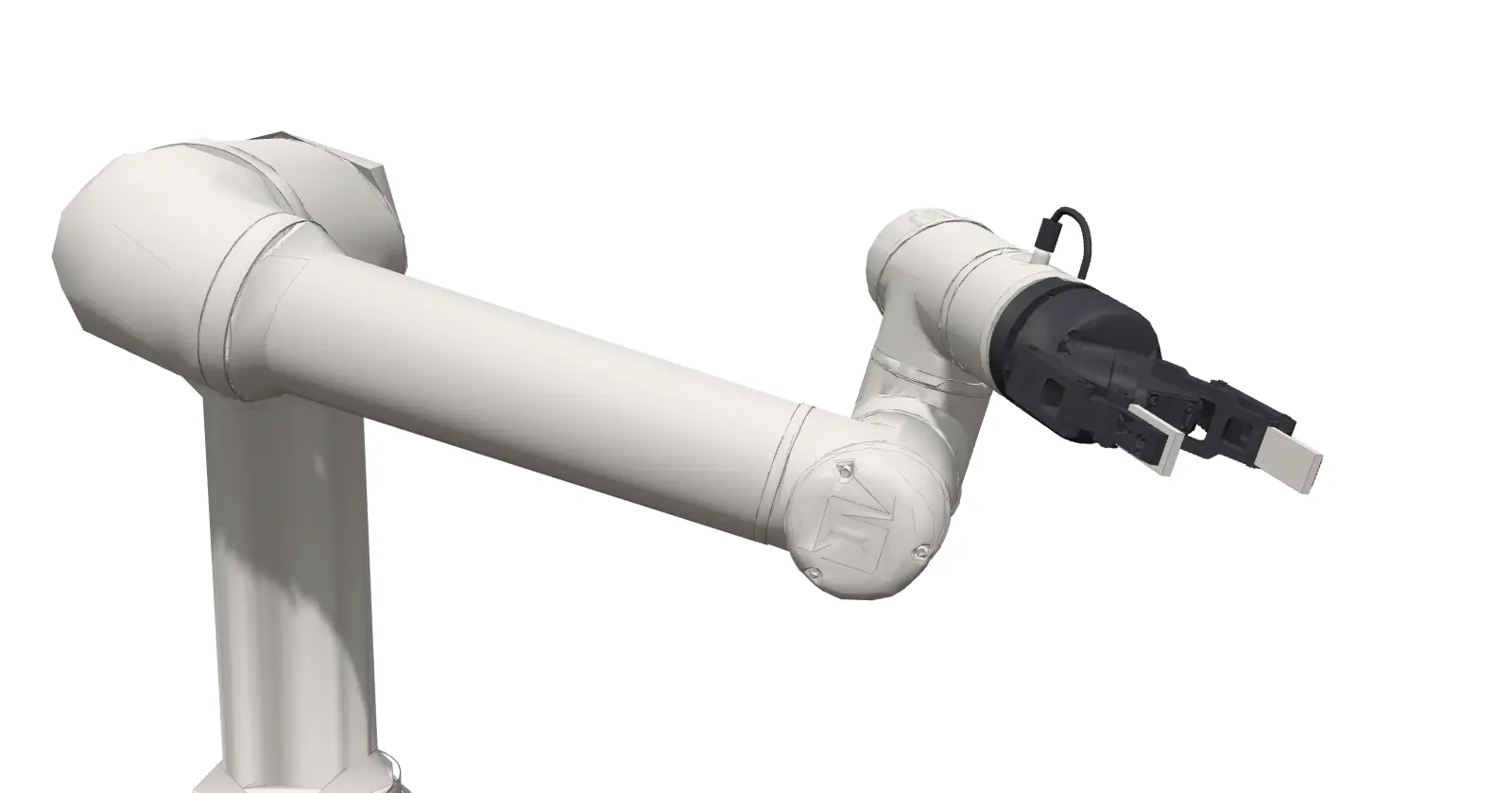
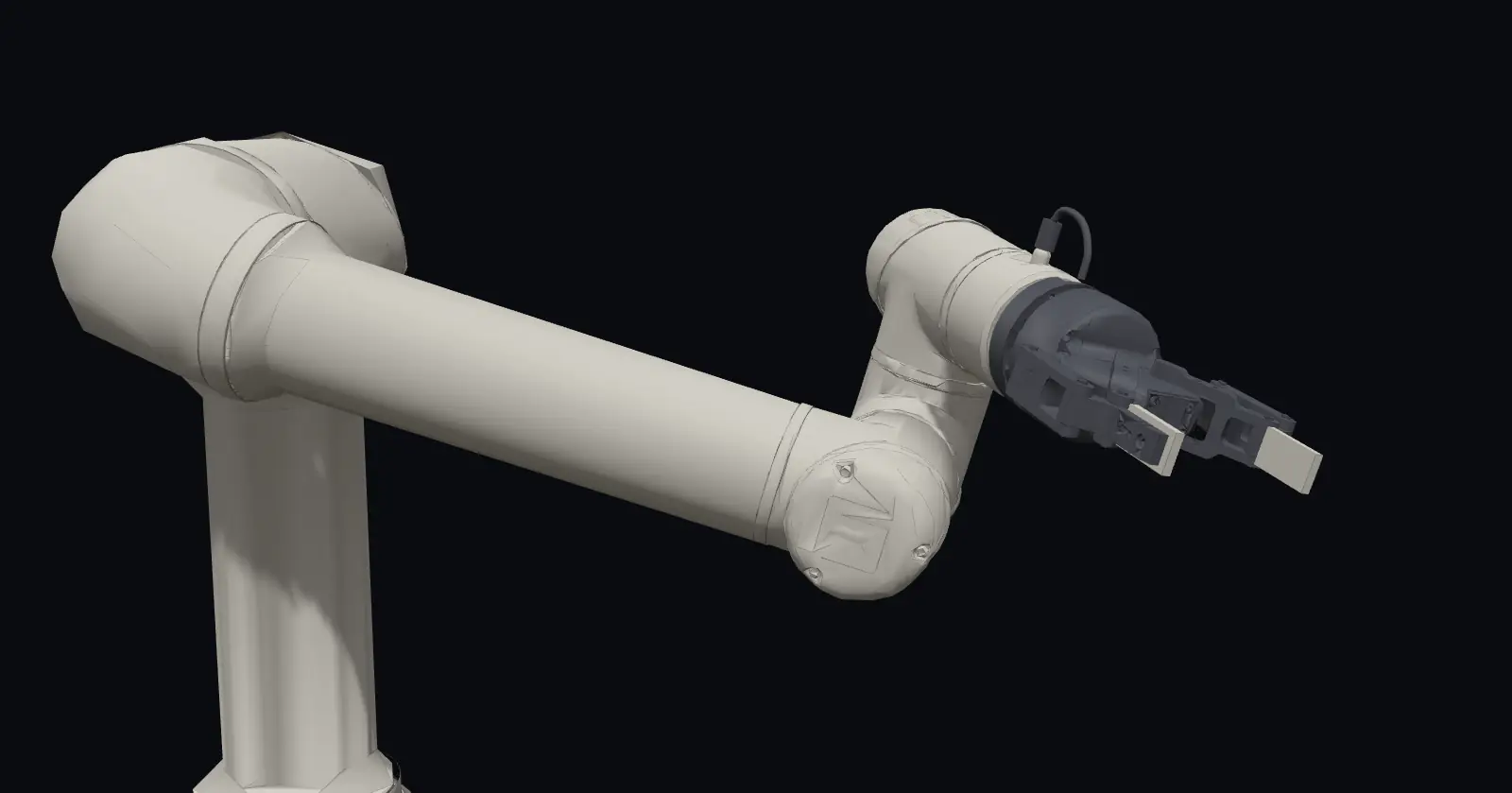
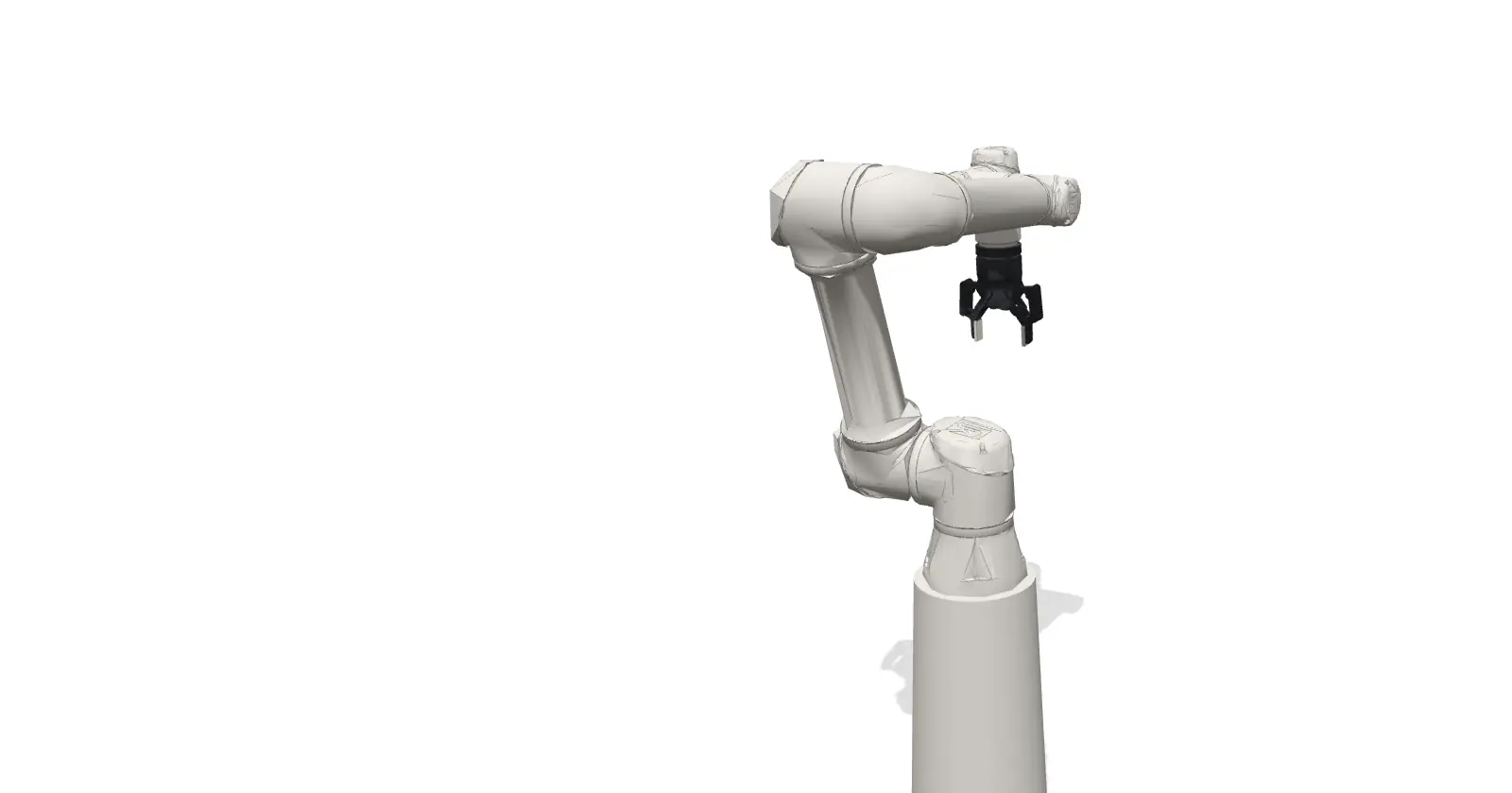
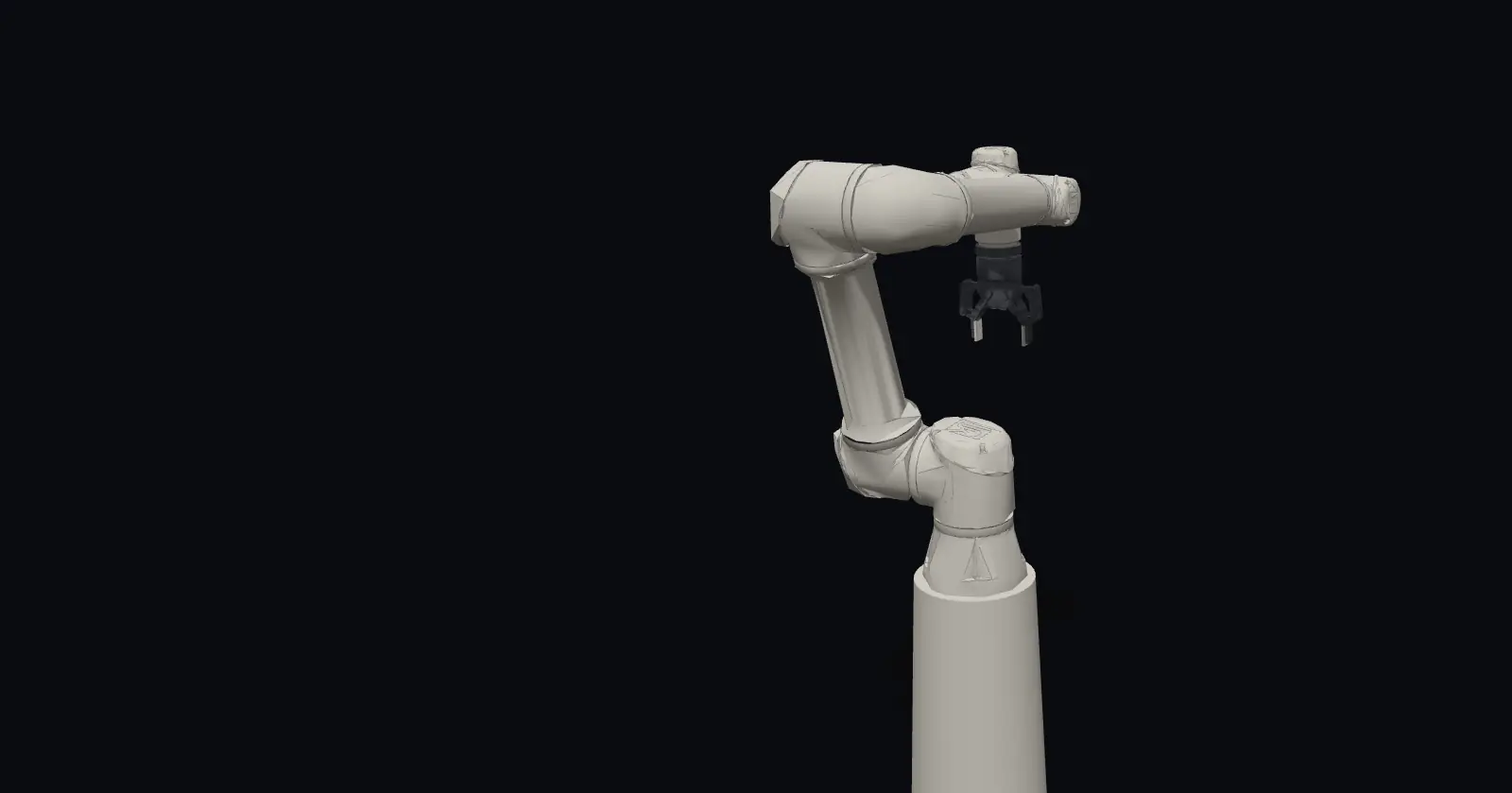
ISO 9409-1-50-4-M6 is a 50 mm bolt circle with four M6 threads. In Atlas, 52 products carry the arm side of it and 26 carry the tool side. Here is one pair.
Field note · planningCheck the reach with the gripper and the part fitted, not from the bare flange.Applications engineer · integrator · example
02 · The flange
ISO 9409-1-50-4-M6
A 50 mm bolt circle, four M6 threads, a 31.5 mm centring bore and one 6 mm dowel pin. UR's datasheet gives the UR5e this flange, and Atlas records it as the arm side.
Review · productionTeach the grip on real parts, not on the CAD model. Soft packaging needs a gentler close.Automation lead · food packaging · example
04 · The wiring
One cable, four signals
A short cable from the coupling plugs into the M8 connector on the UR wrist. Atlas has both ends on record: it matches the 24 V supply, and the signals line up by name.
Spec correction · proposedFM855-E1: the 0.69 mm depth accuracy is stated at 800 mm. Add that condition to the value.Vision engineer · integrator · example
11 · The link
Camera to robot, hop by hop
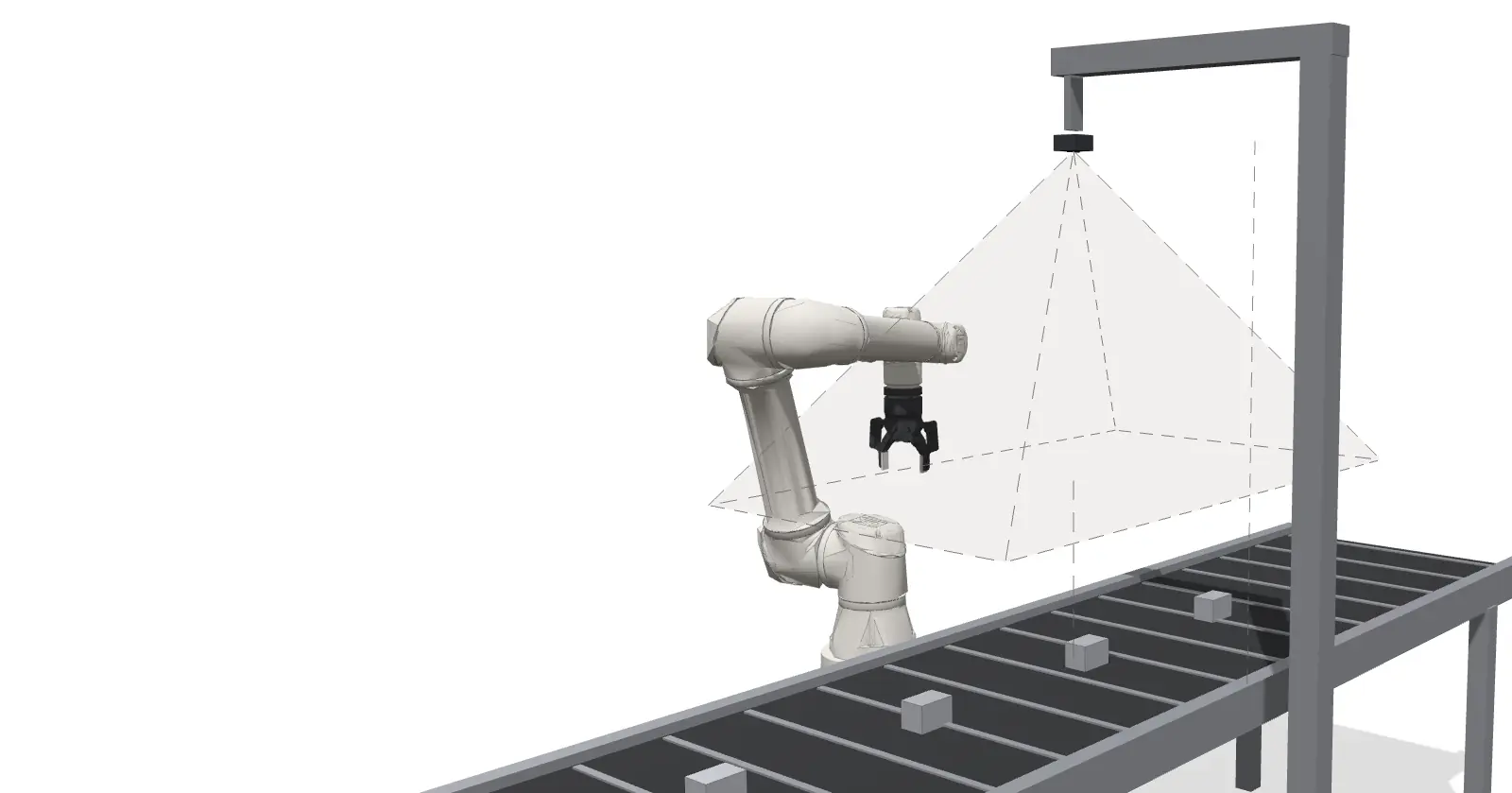
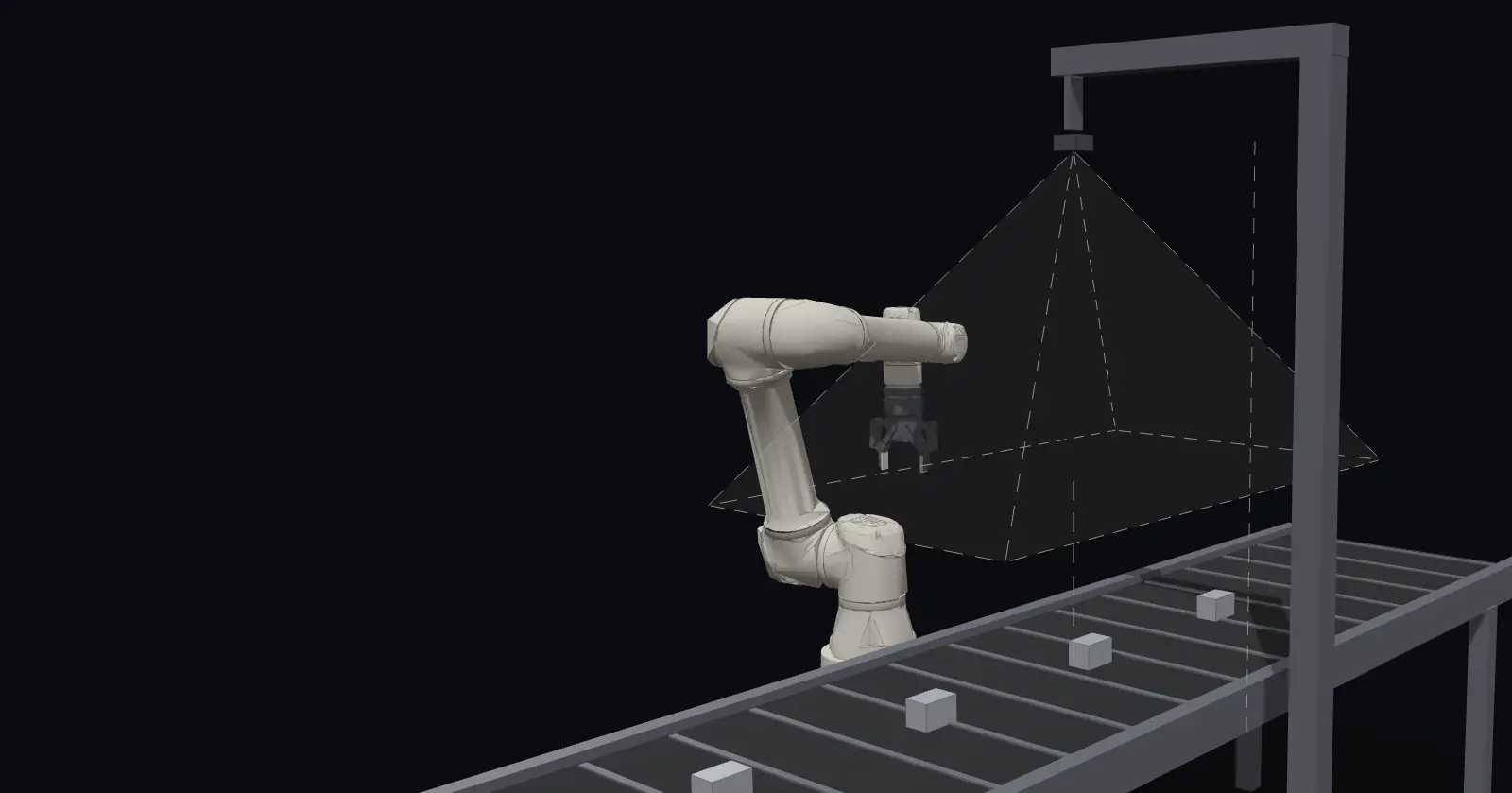
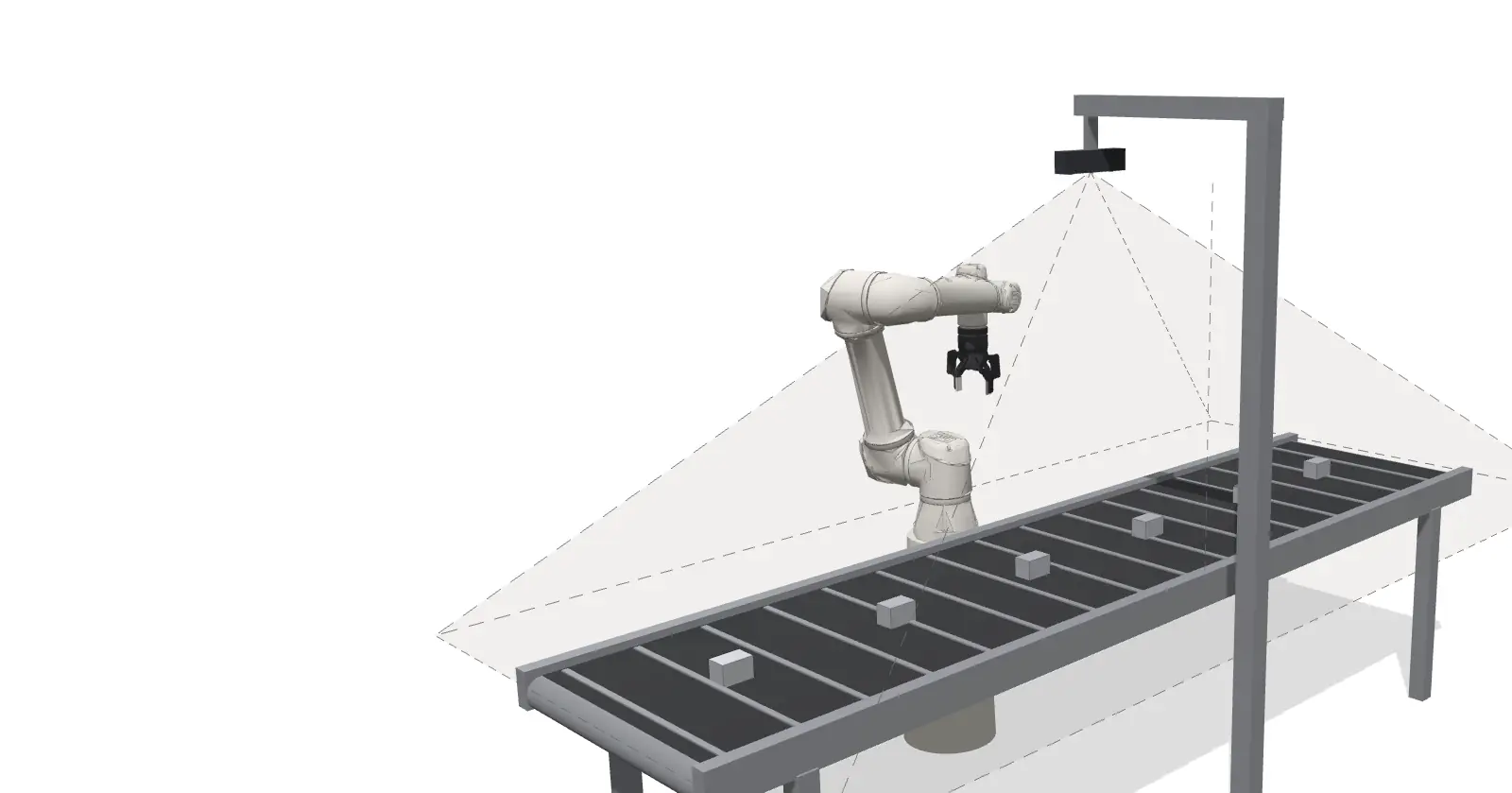
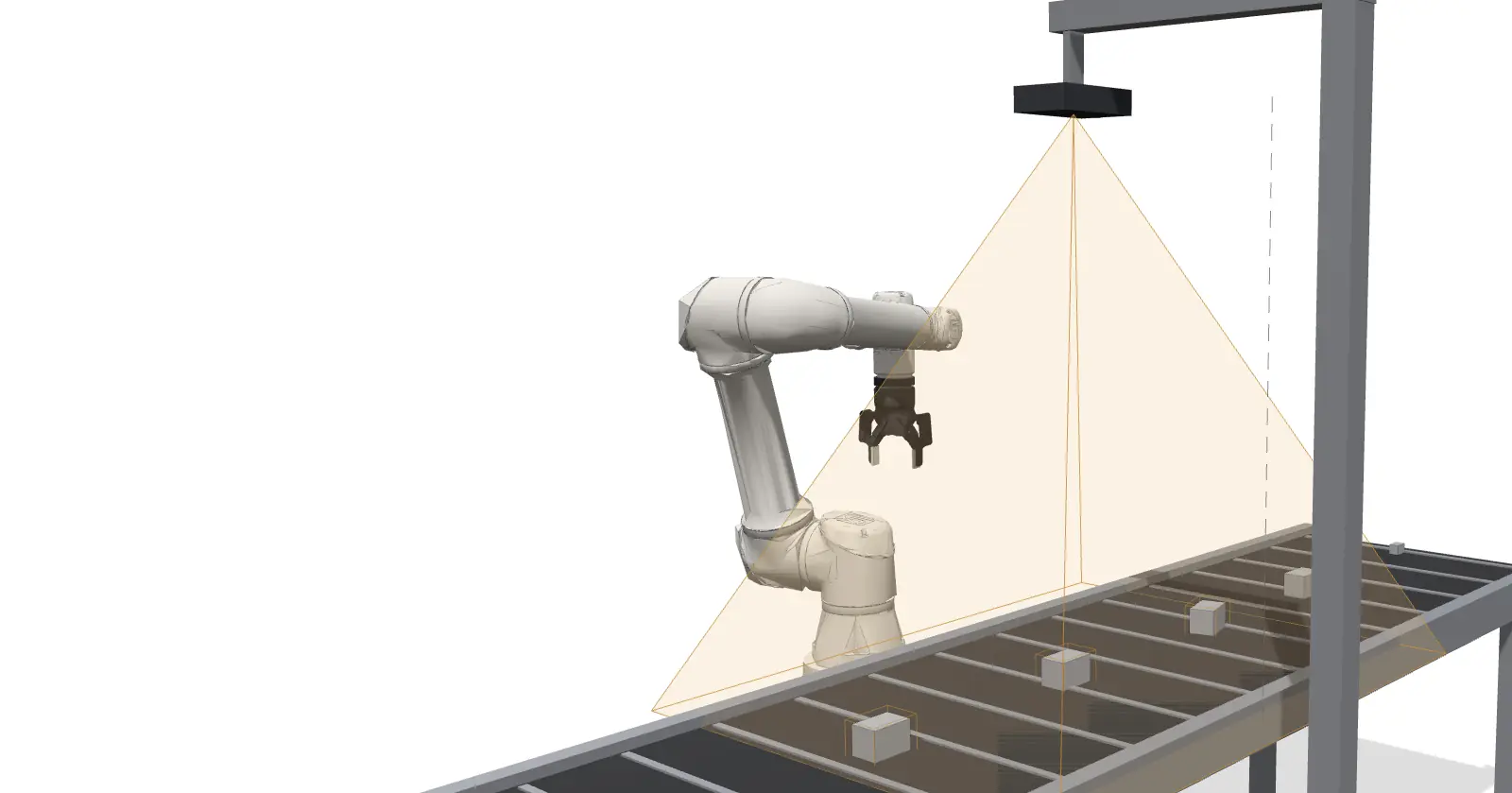
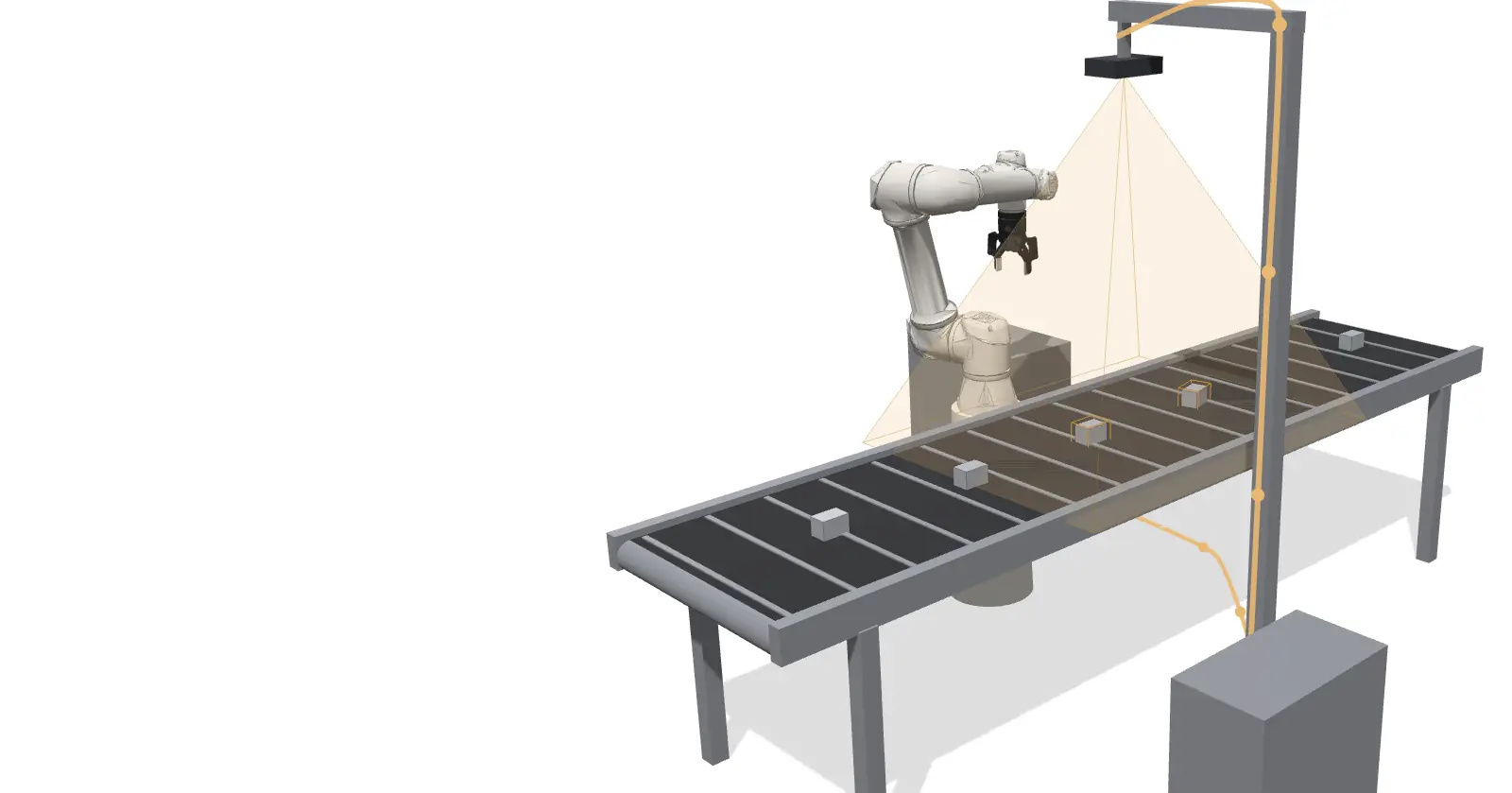
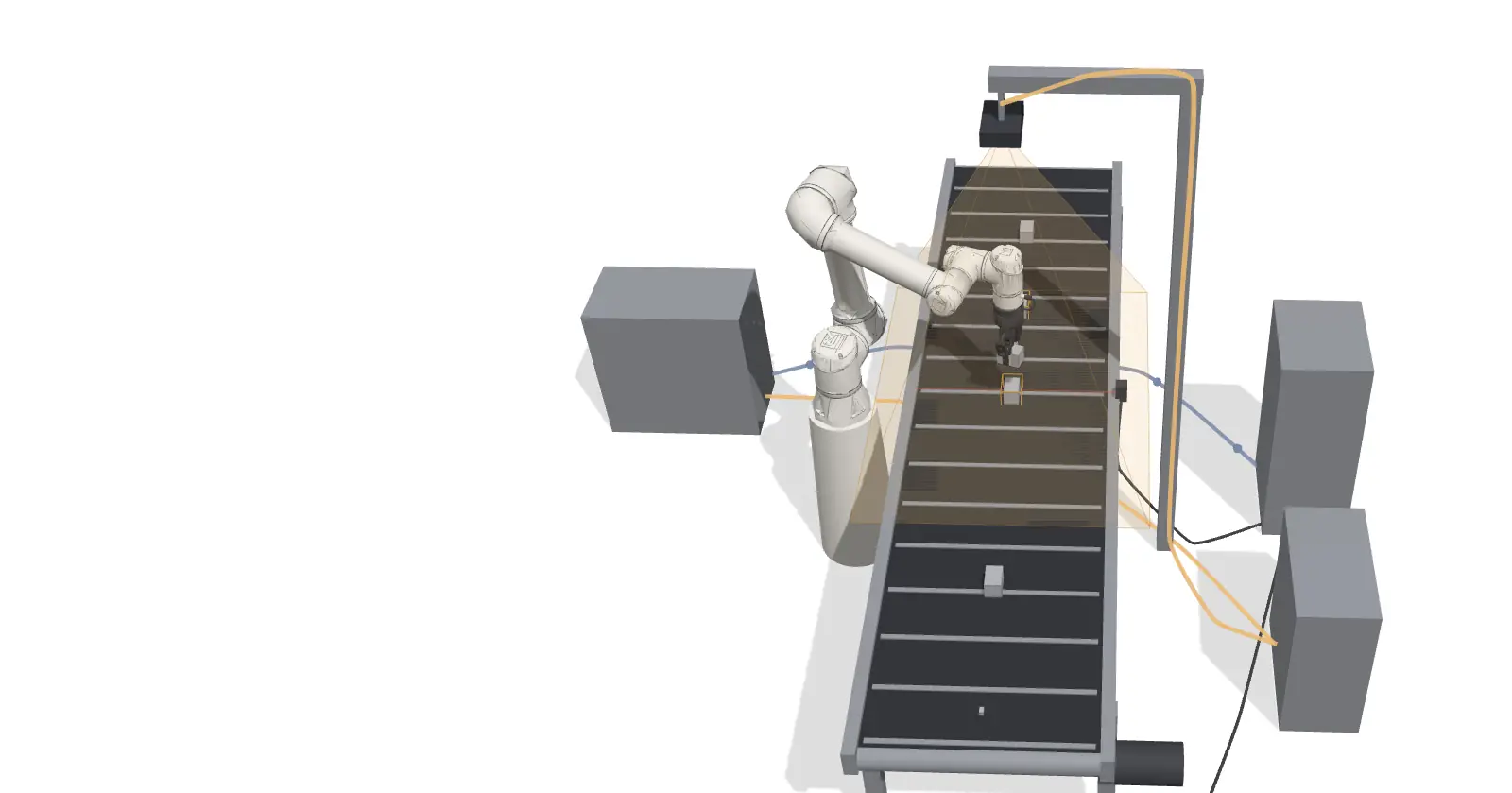
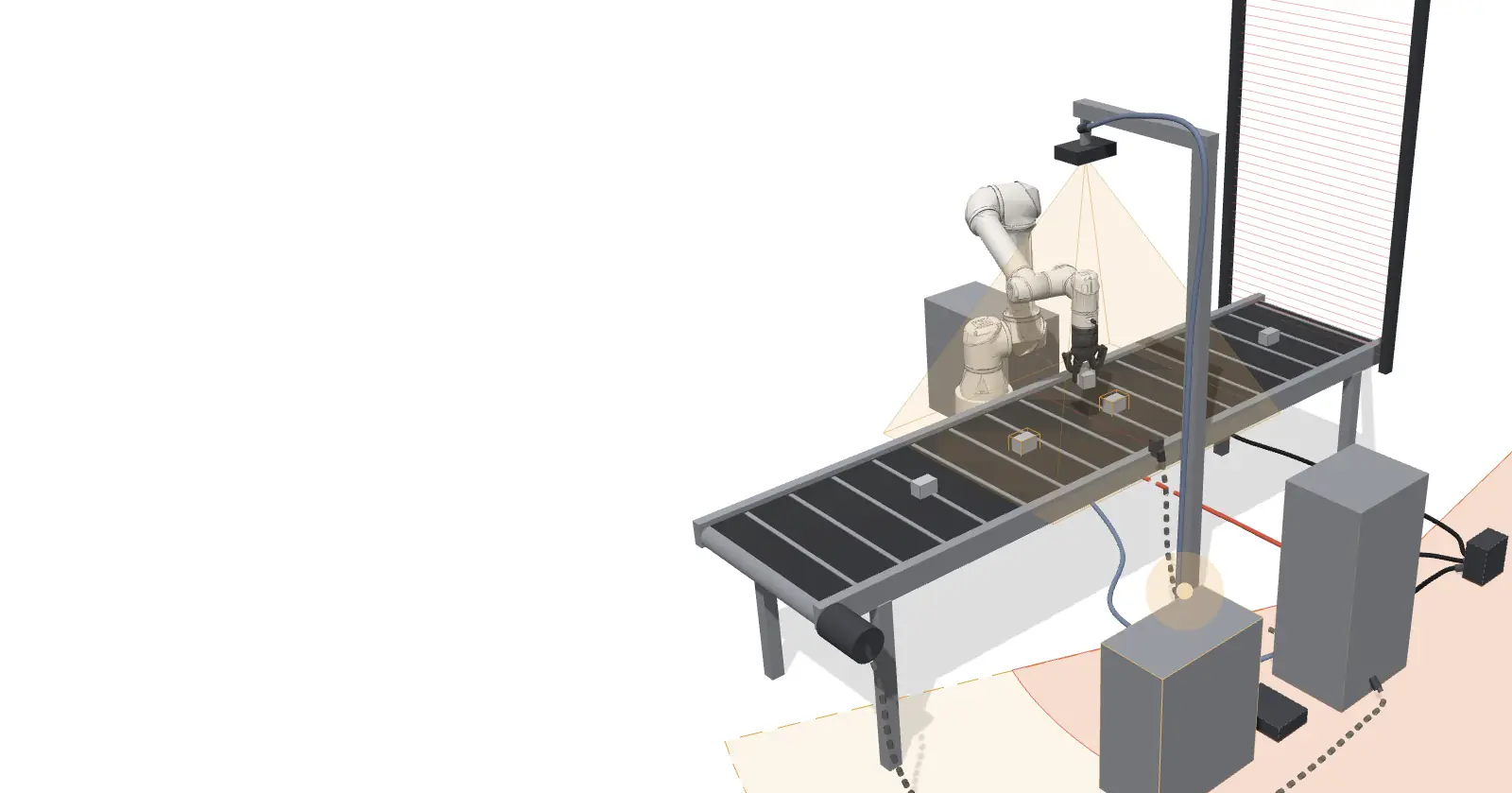
A 3D camera doesn't talk to the robot directly. A vision PC sits between them, and every hop needs a fact on both sides.
Cable
On record, both endsGigabit Ethernet on the camera (M12 X-coded, PoE) and on the UR5e control box.
Camera driver
MatchedPercipio's ROS 2 driver on ROS 2 Humble, Ubuntu 22.04.
Vision
Needs integrationFoundationPose reads the camera's depth, RGB and intrinsics, and Atlas matches all three. It still needs a CUDA GPU on Linux and the part's mesh, and its licence is for research use only.
Robot driver
MatchedUR's ROS 2 driver, also on Humble and Ubuntu 22.04.
Calibration
Once, at setupHand-eye calibration maps the camera's frame onto the robot's base.
Field note · commissioningGive the camera its own network port on the vision PC, apart from the robot's.Controls engineer · integrator · example
12 · The pick
The arm picks what the camera found
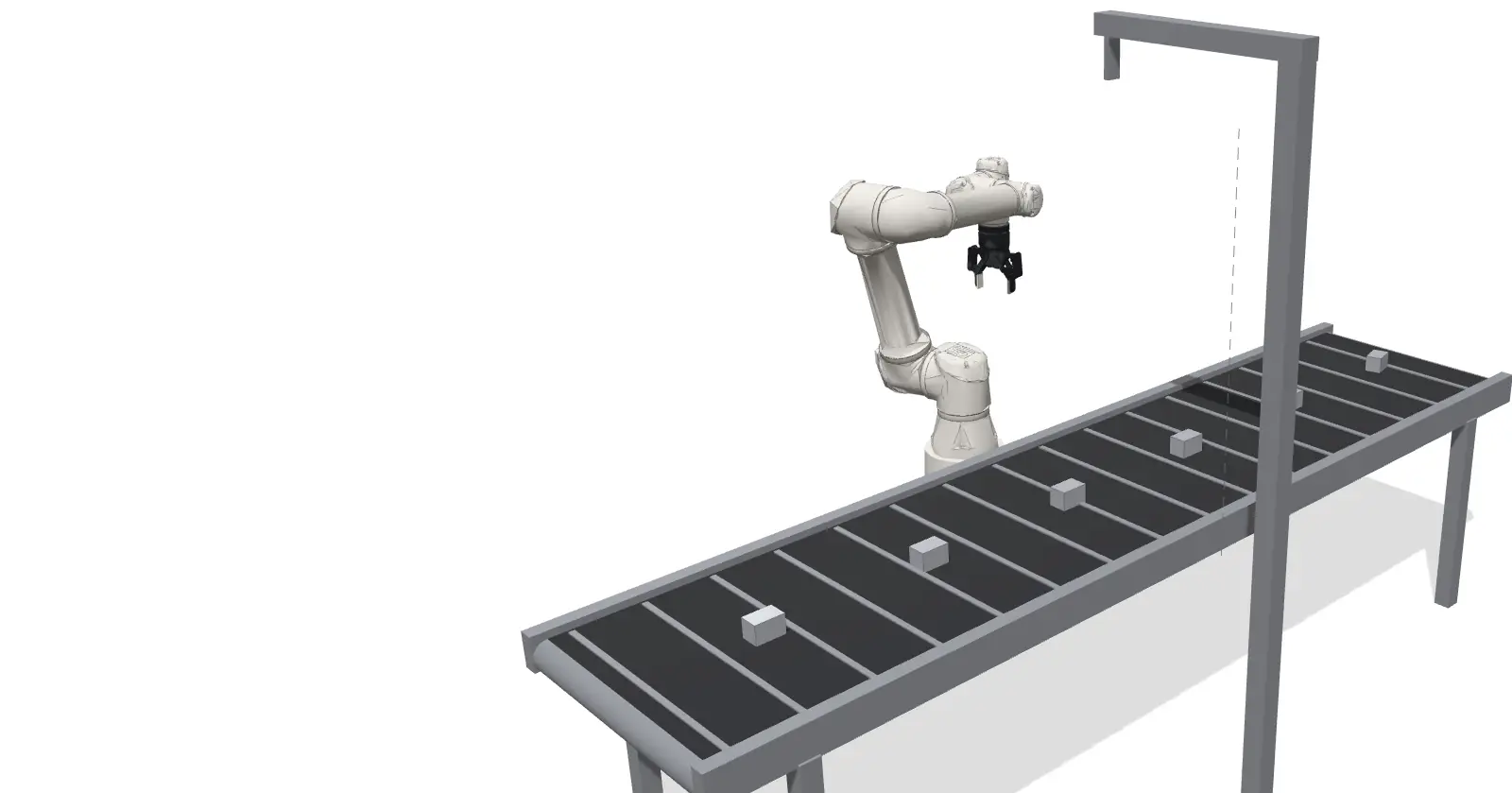
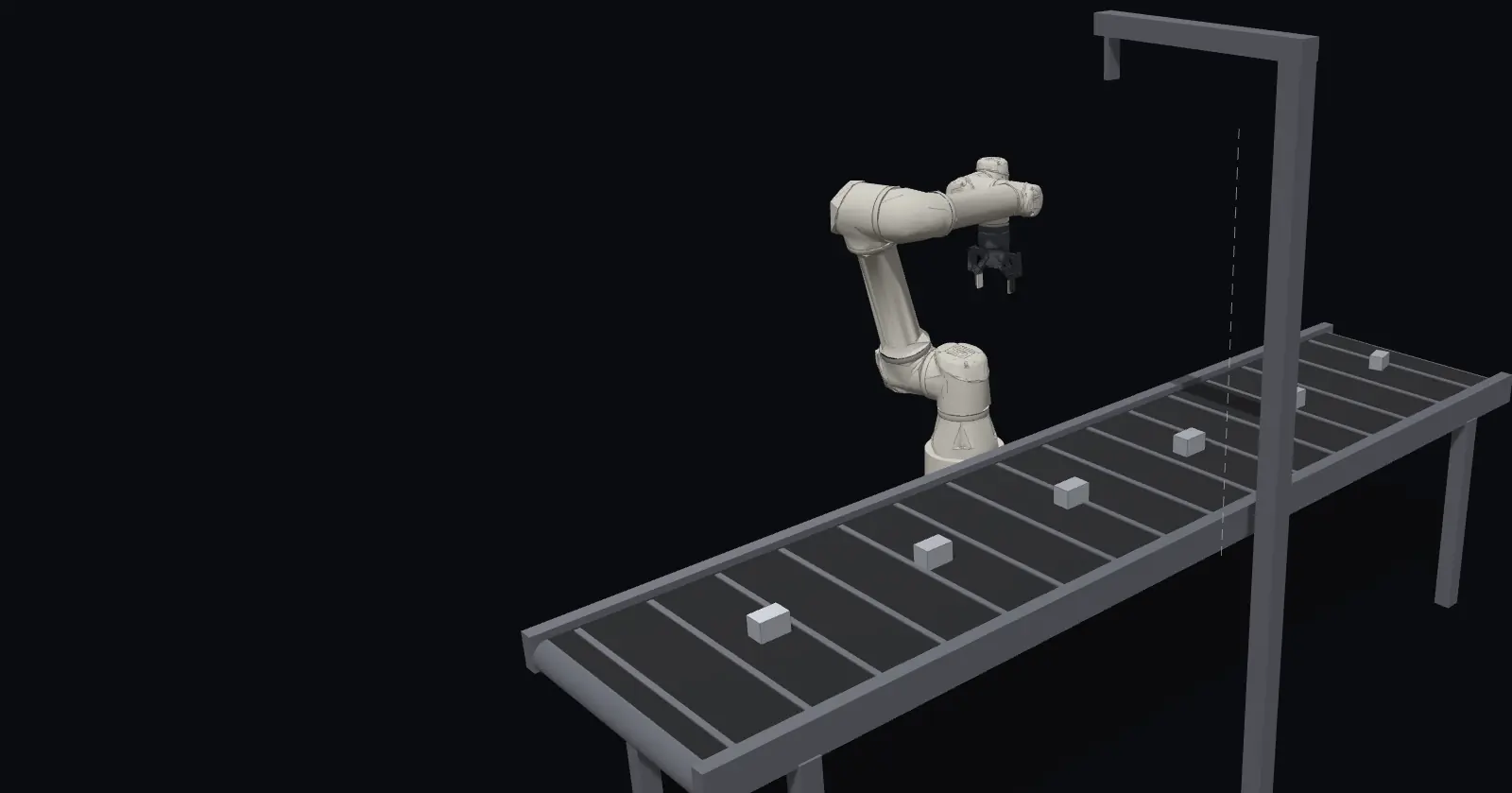
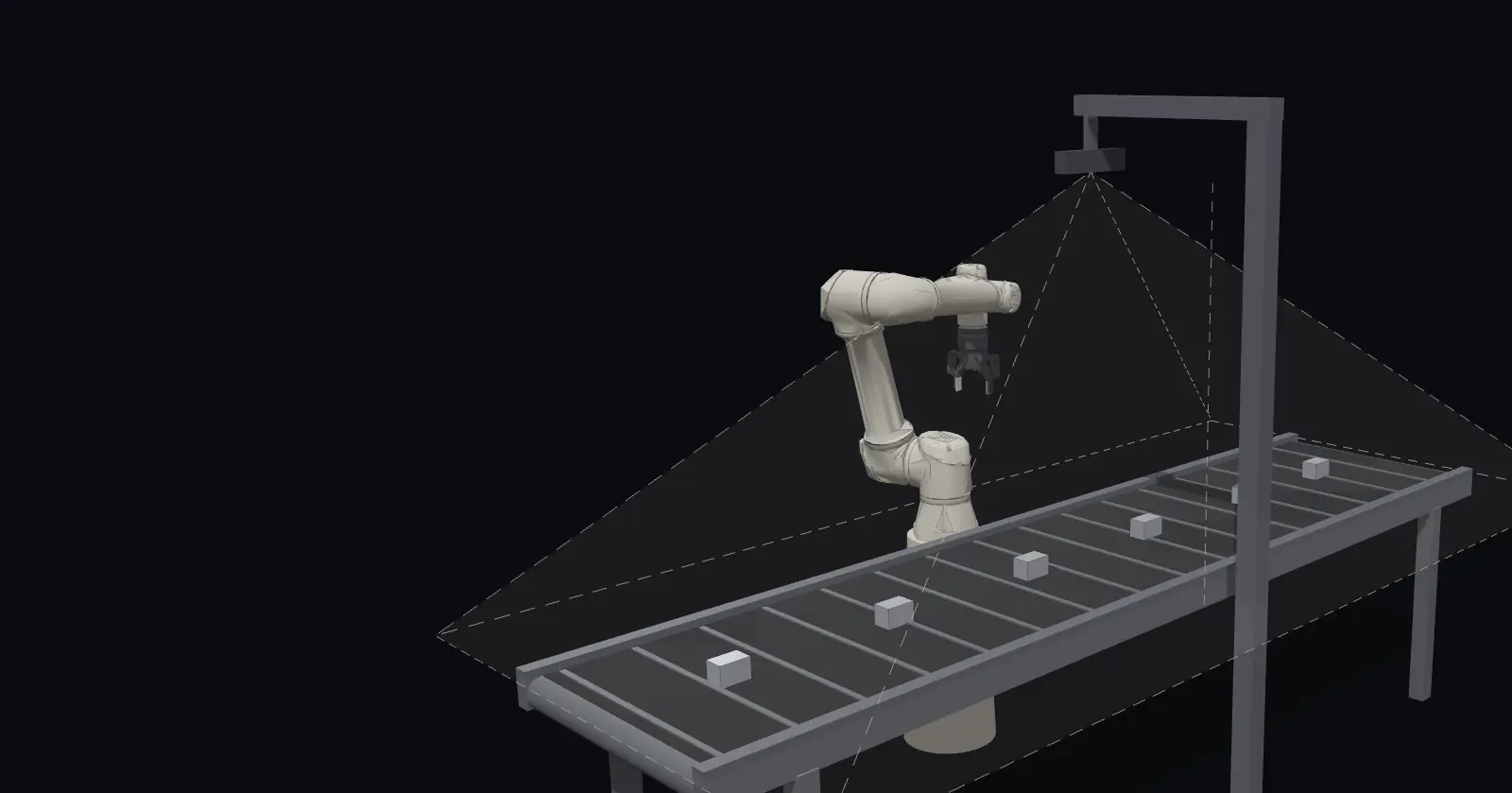
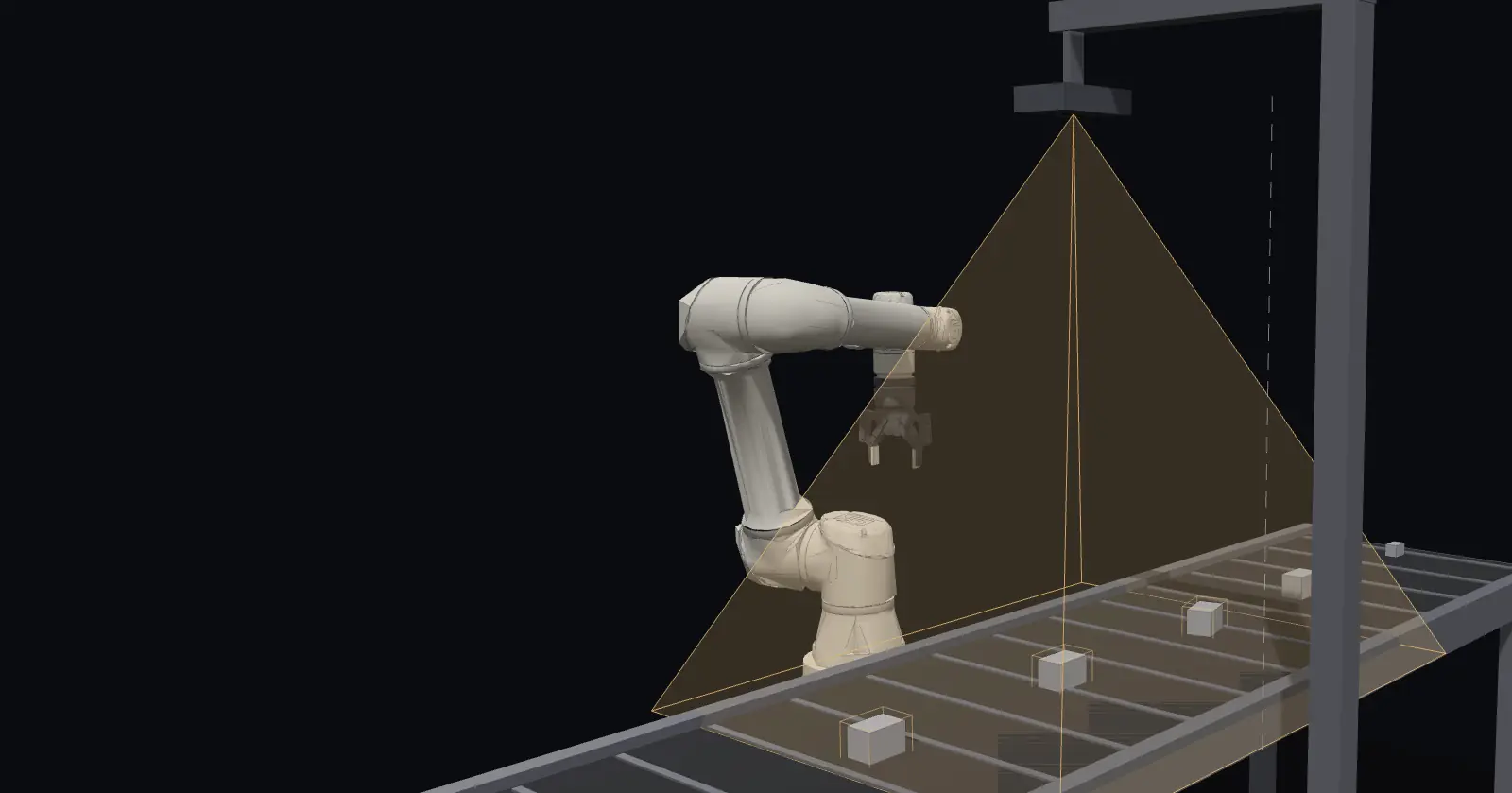
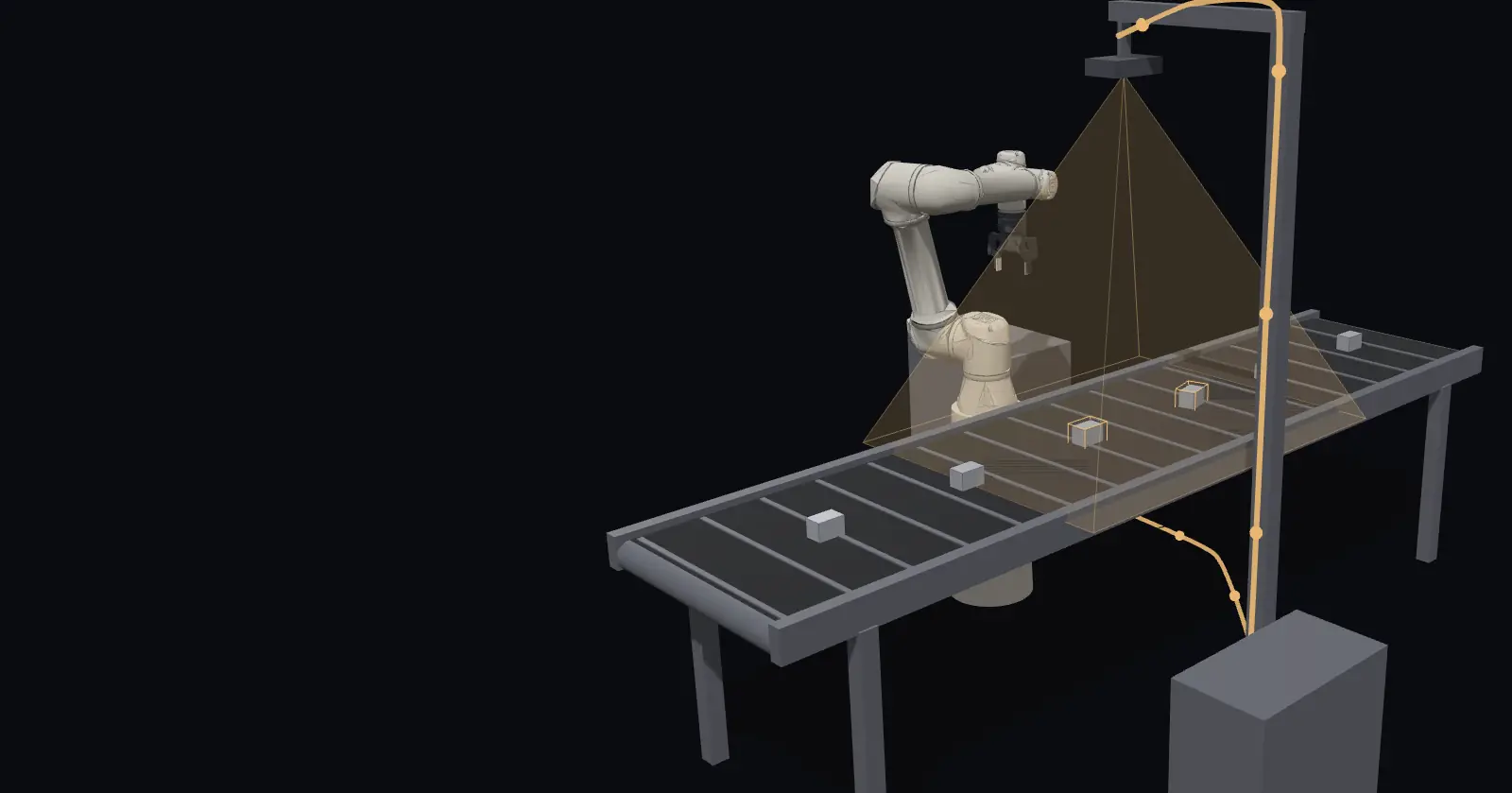
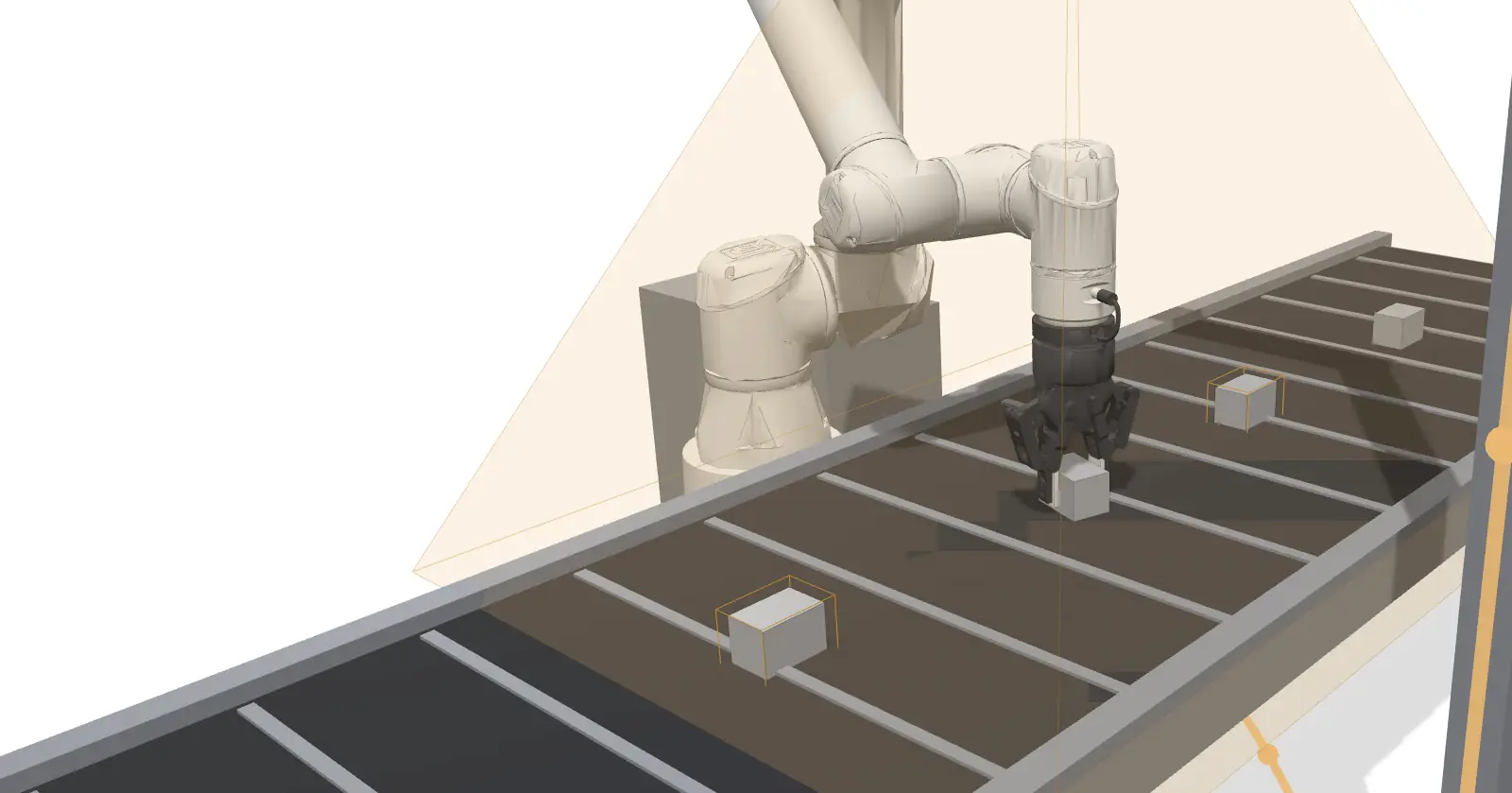
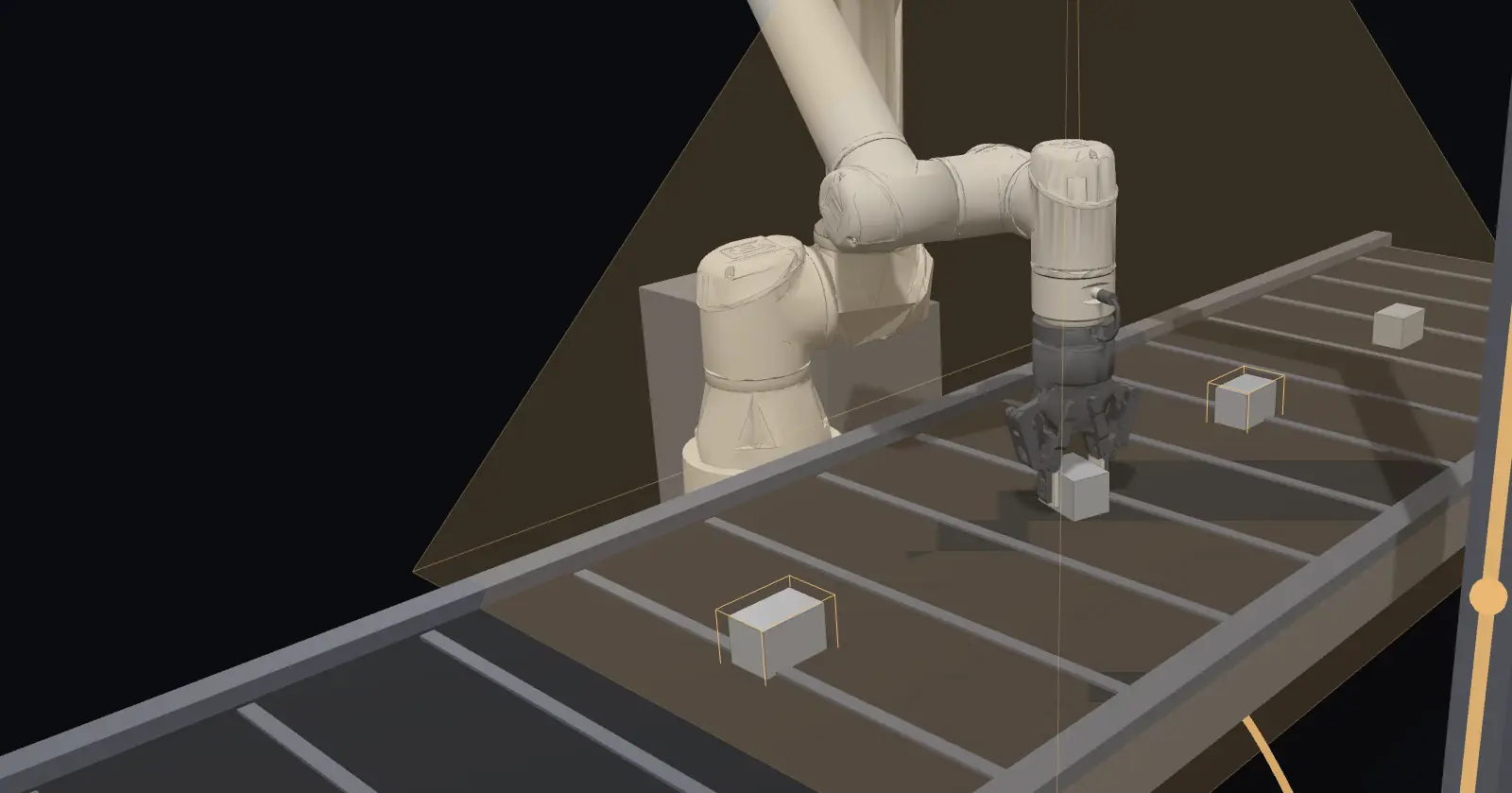
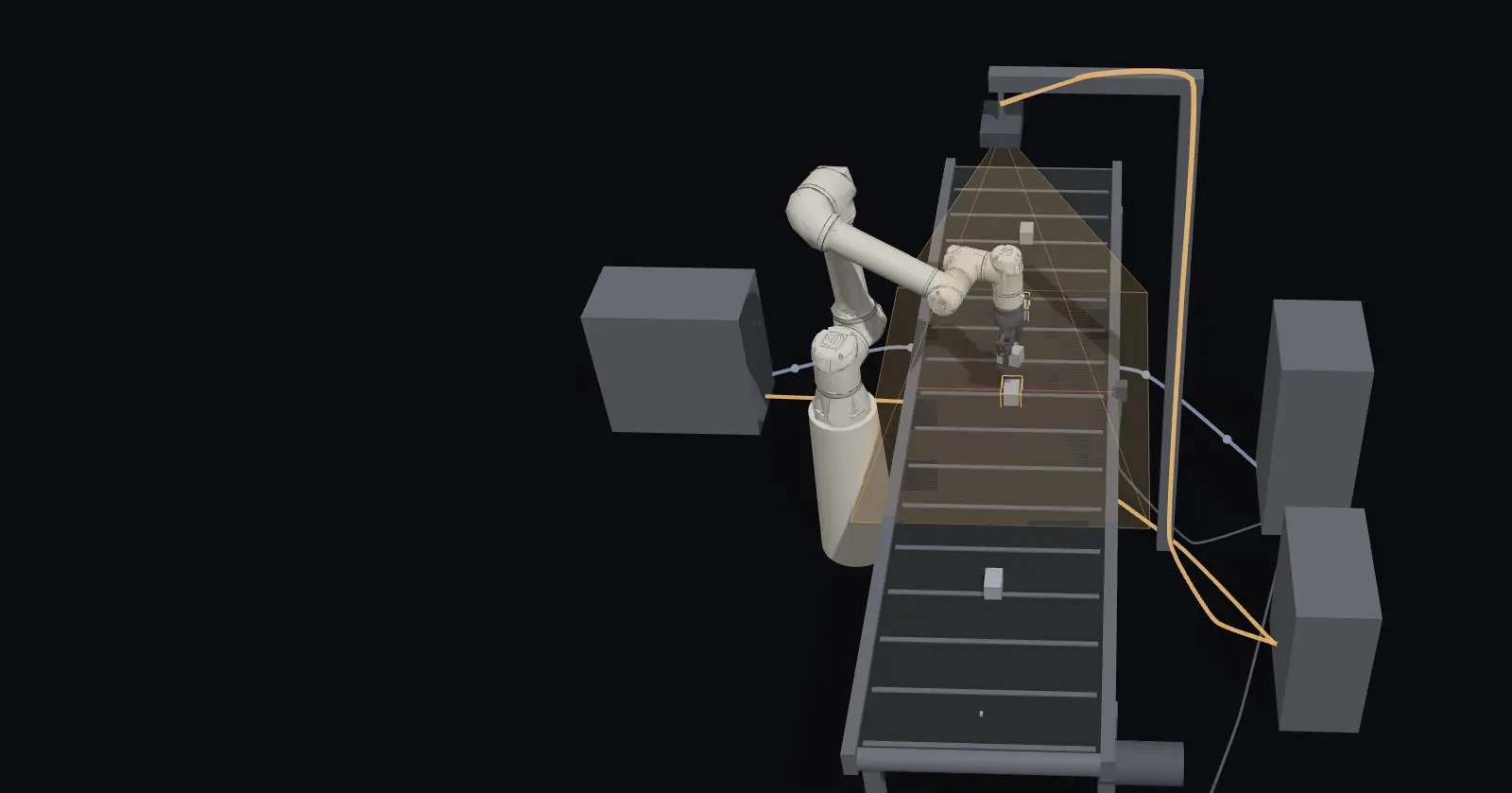
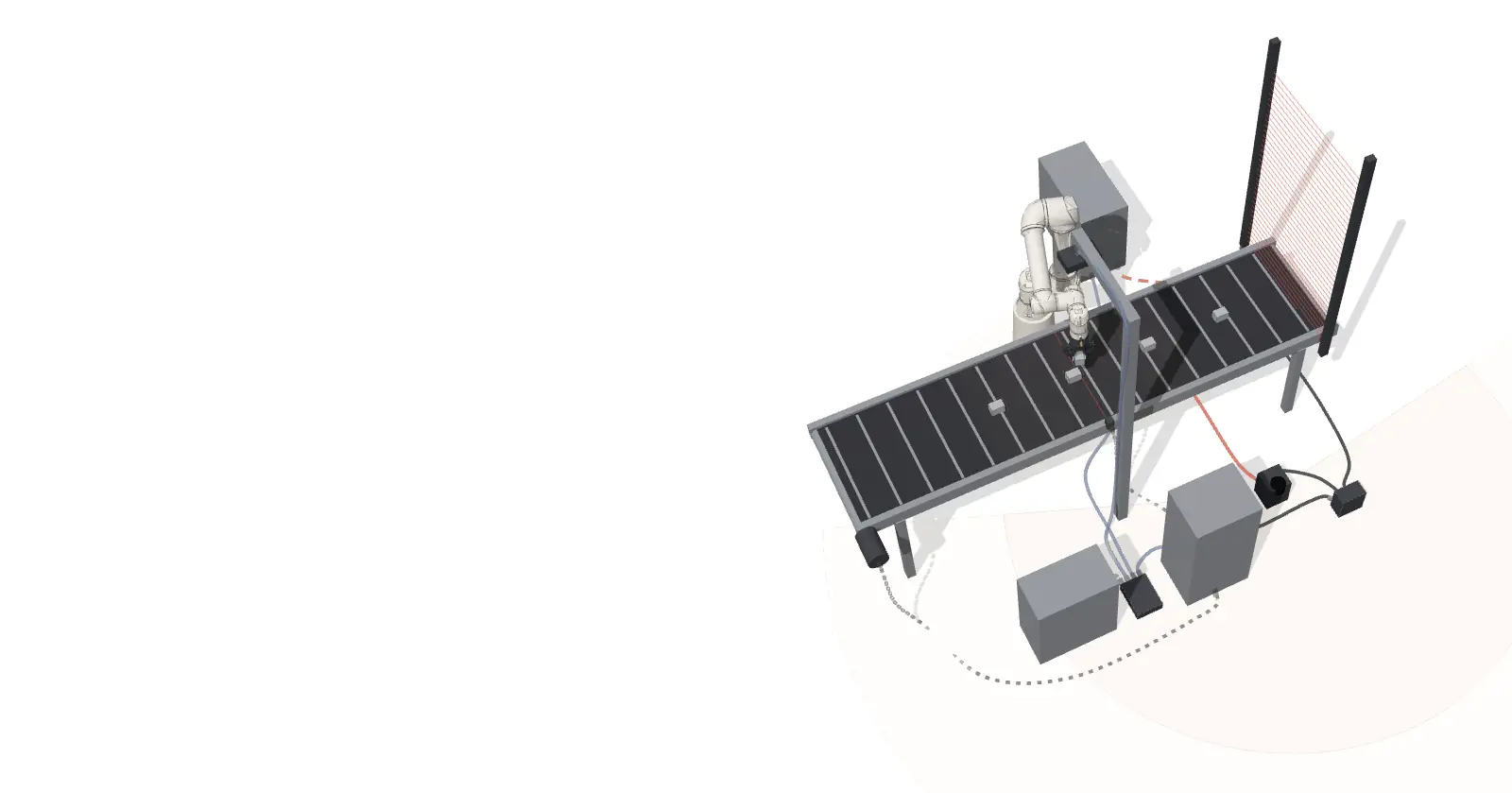
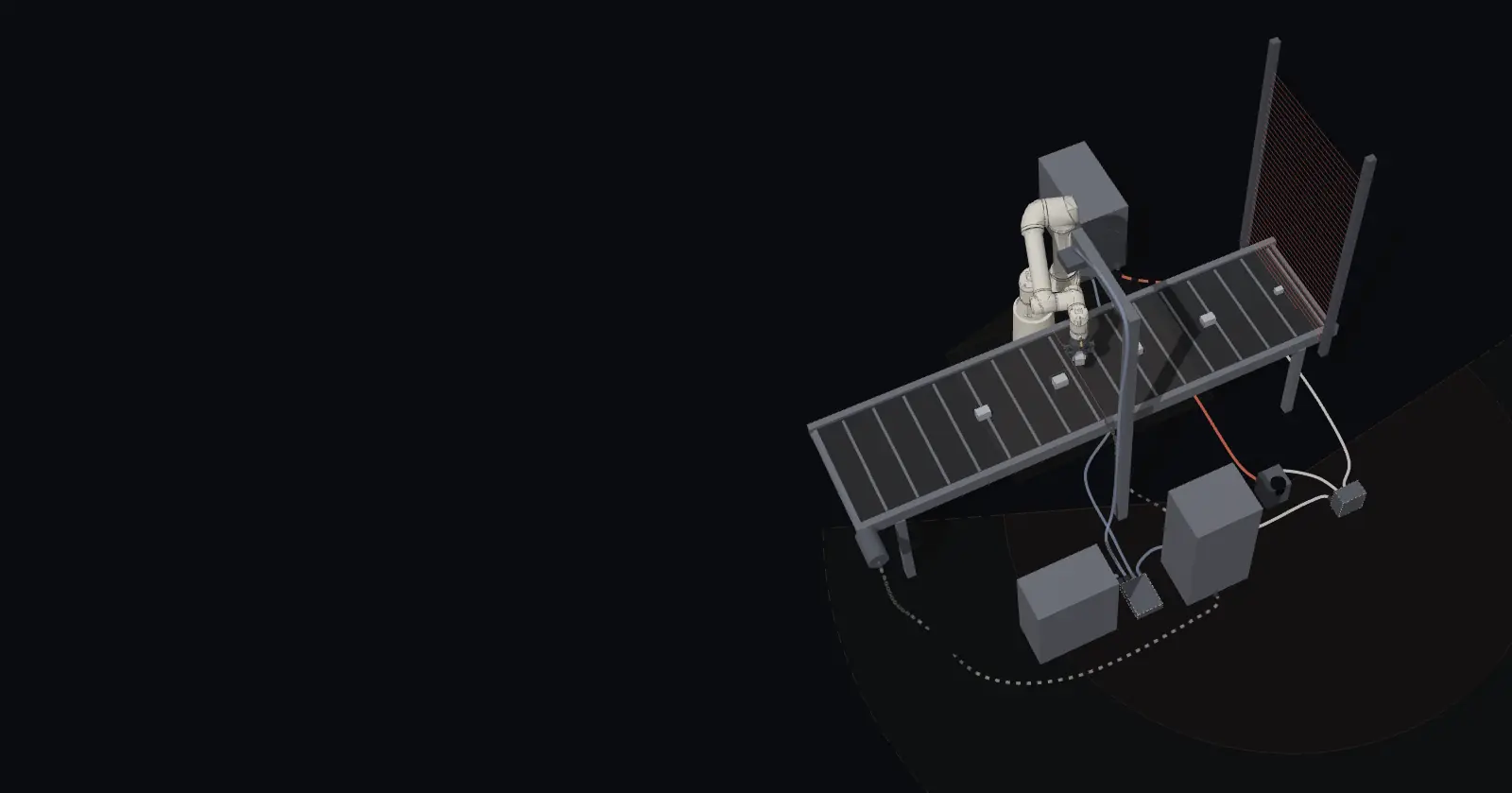
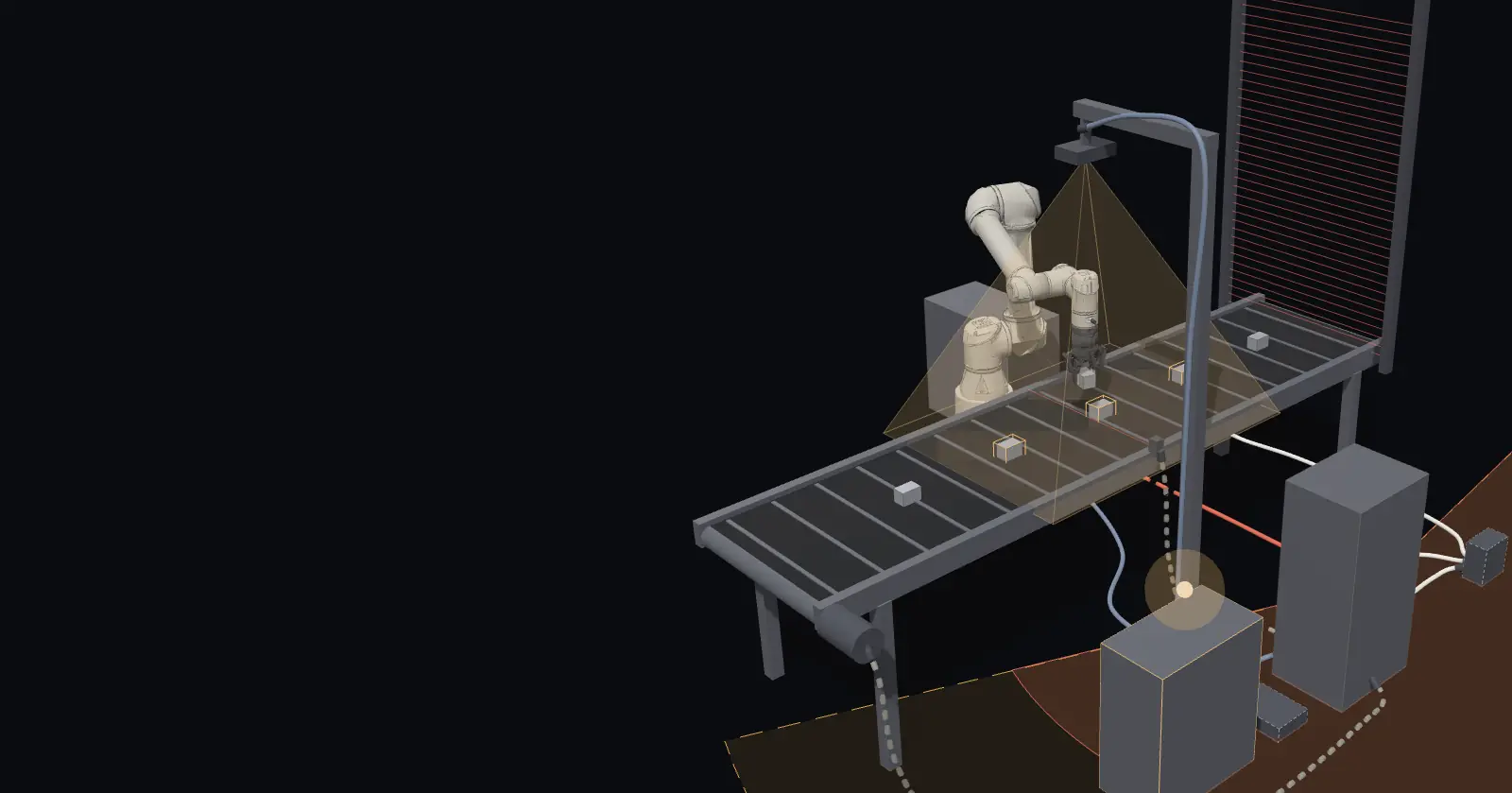
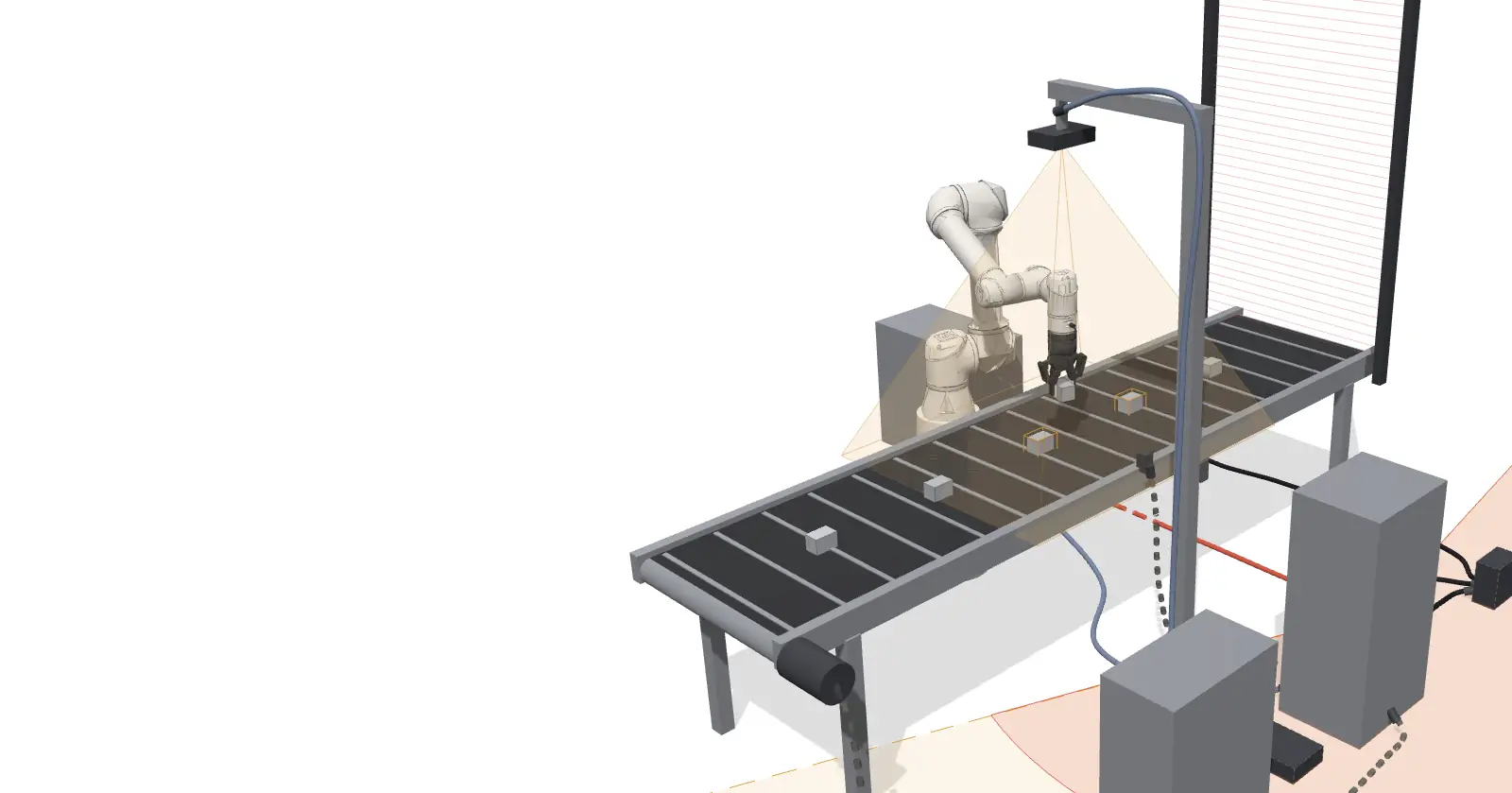
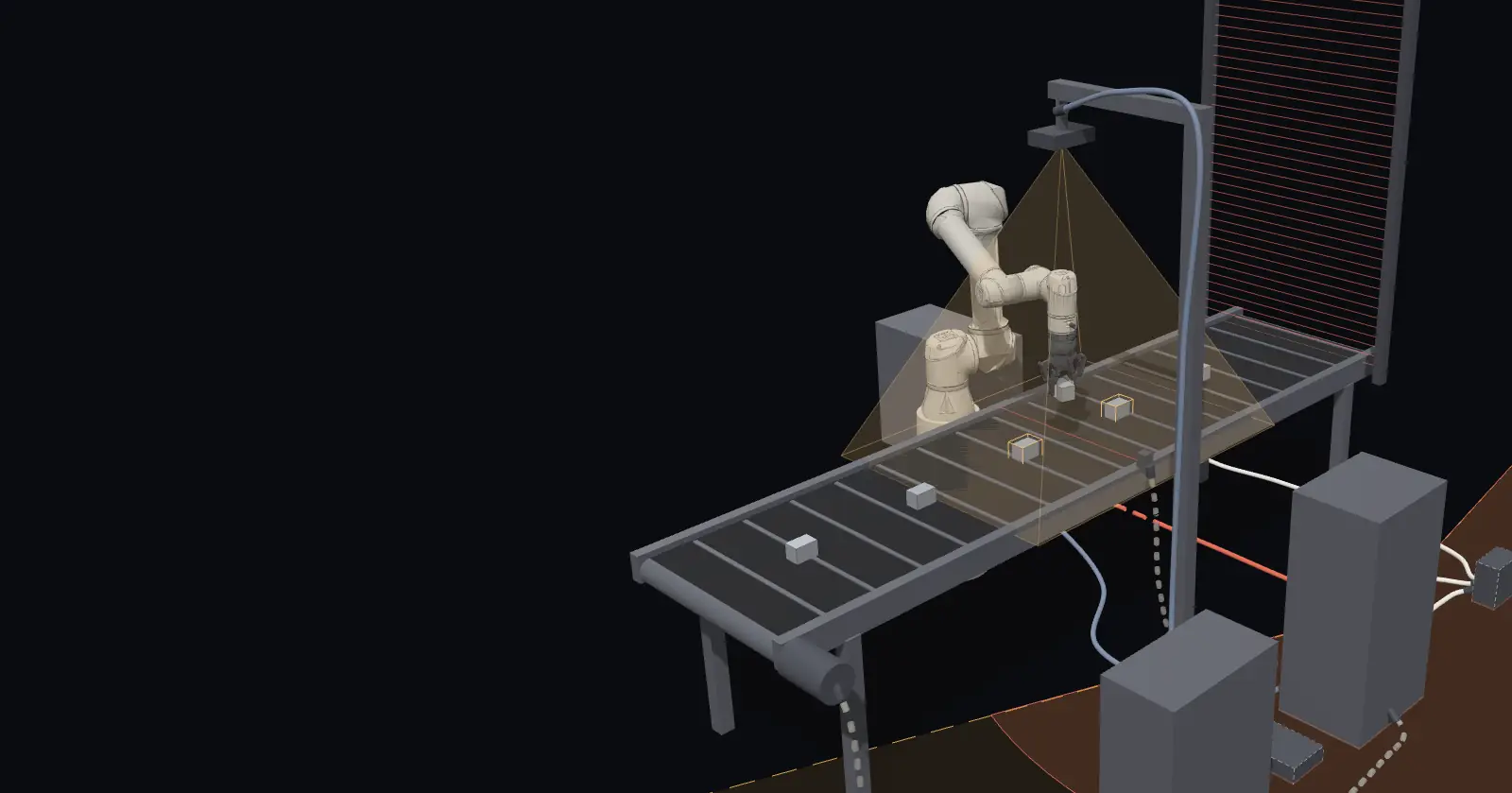
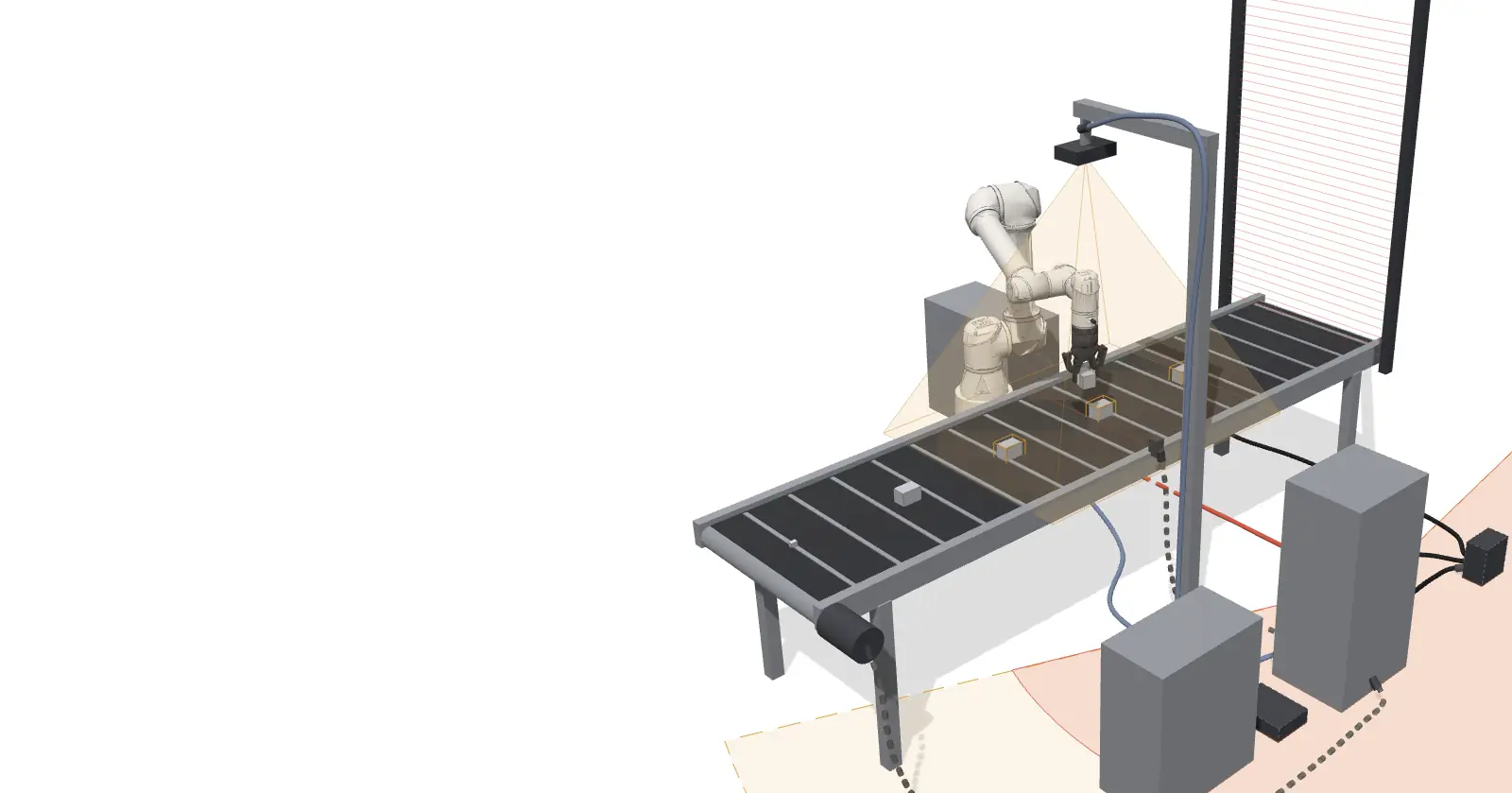
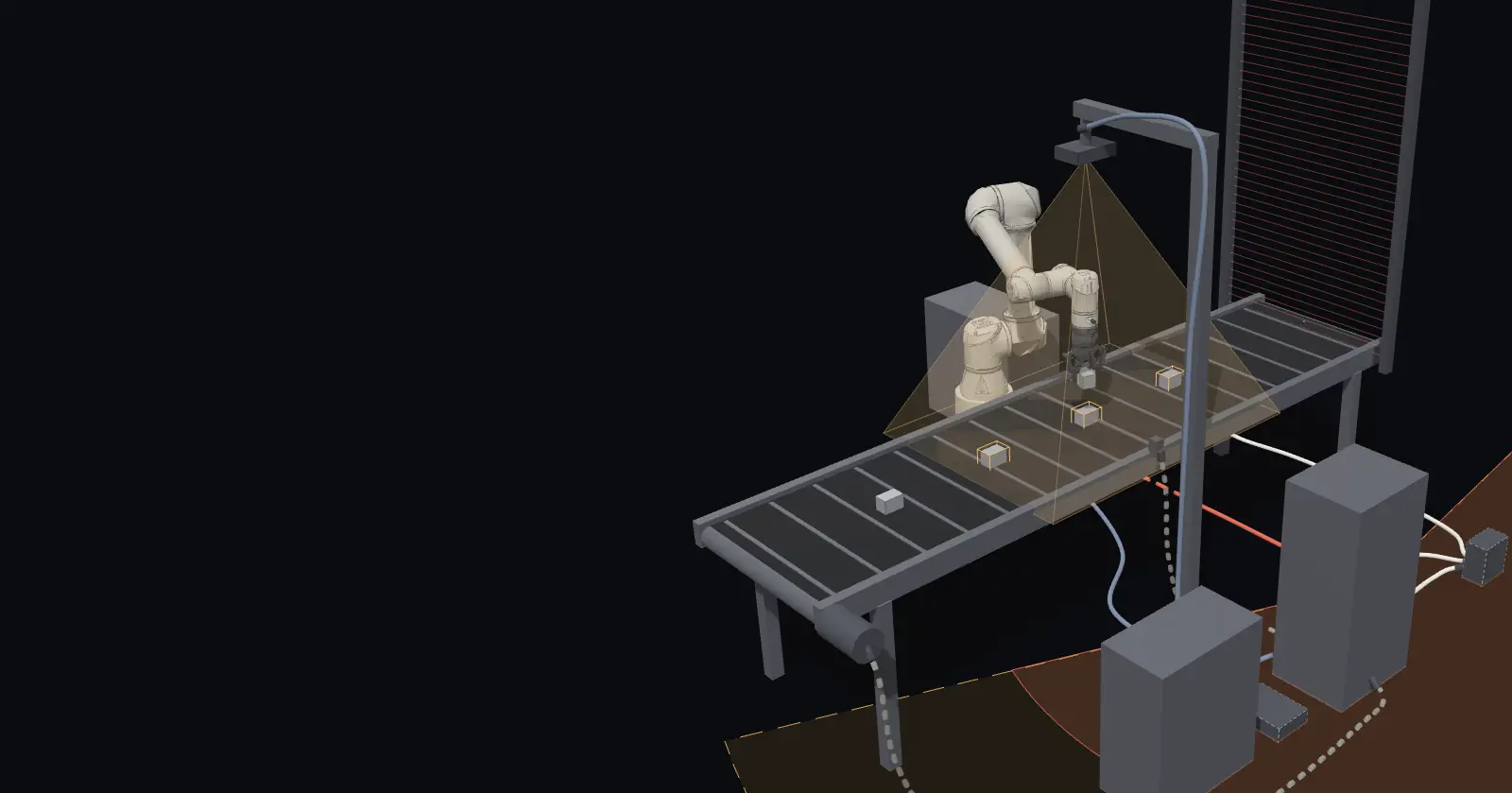
The camera sees the part, the vision PC turns it into a pose, and the UR5e closes the 2F-85 on it. Every part of this cell came out of Atlas, each fact with its source.
Field note · commissioningAgree the two handshake bits with whoever writes the PLC program before the robot arrives.Controls engineer · machine builder · example
14 · Safety
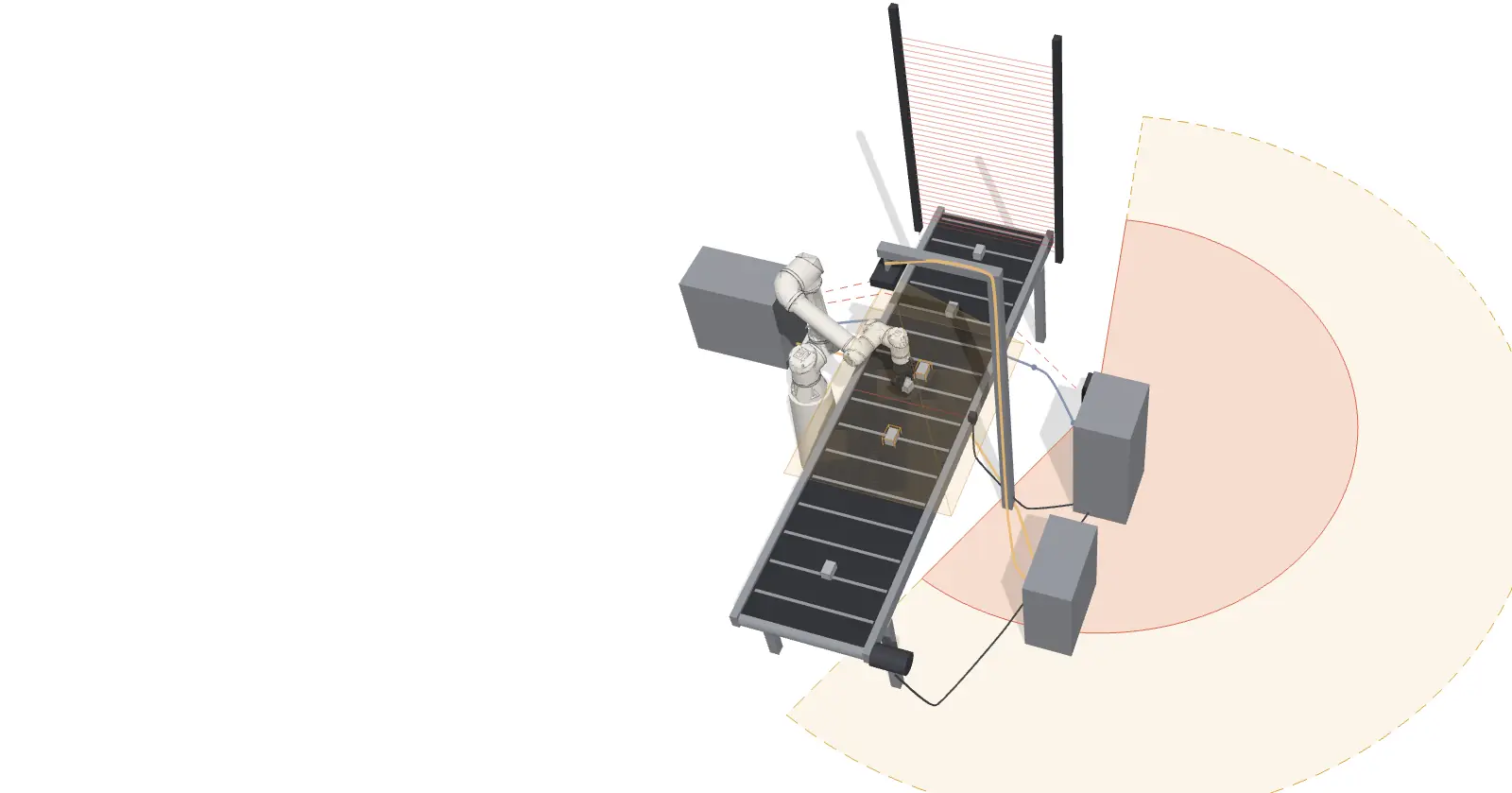
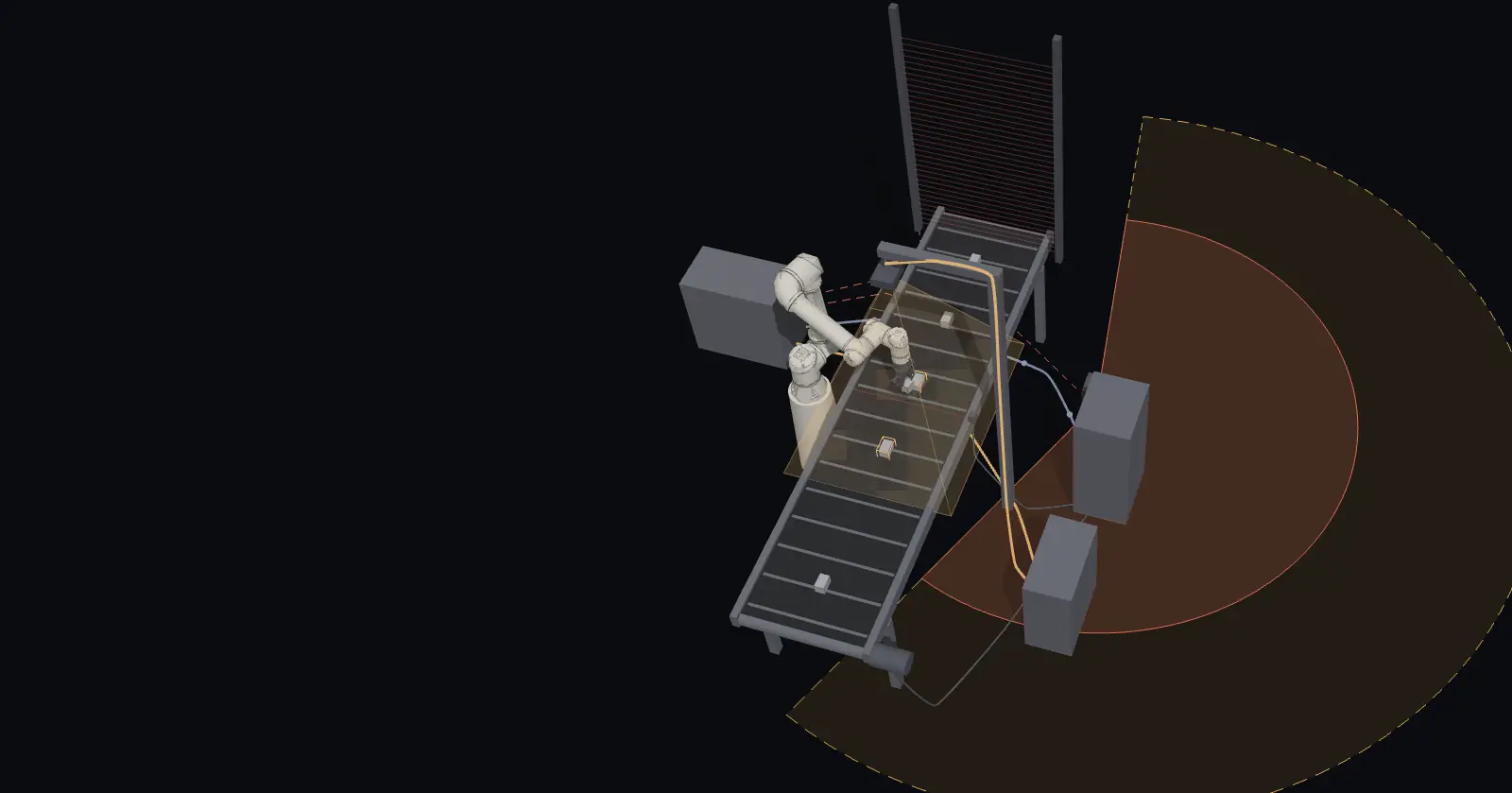
What the risk assessment usually asks for
Approach
SICK microScan3 Core I/OLaser scanner on the floor. 275°, protective field up to 5.5 m, 70 ms, PL d / SIL 2. The robot slows, then stops, as someone walks in.
Infeed
Leuze MLC 500, 30 mmLight curtain where parts are loaded. Type 4, PL e / SIL 3, 1050 mm high, 10 ms. A hand through it stops the belt and the arm.
Robot
Built in17 configurable safety functions, PL d Cat. 3 to EN ISO 13849-1 (UR datasheet).
Wiring
Half on recordScanner pins 2 / 4 (OSSD 1.A / 1.B) and curtain pins 5 / 6 (OSSD1 / OSSD2) are in Atlas. They land on a UR5e safety input pair, such as Safeguard Stop, which UR's manual documents but Atlas can't record yet.
Field note · safetyMeasure the robot's real stopping time before you size the scanner's protective field.Safety engineer · integrator · example
15 · Wiring
Every cable, end to end
Twelve cables hold this cell together, and each end needs a fact: connector, gender, pins. Follow the light from cable to cable, or pick one in the cell.
01 / 12M8 8-pin · 4 signals
On record in AtlasToolM8 8-pin · 4 signals
UR5e wrist, built before Sep 2024M8, 8-pin, male
1 · white · AI2 / RS485+
2 · brown · AI3 / RS485−
5 · grey · POWER (12/24 V)
8 · red · GND
⇄
Robotiq 2F-85 coupling cable8-pole, female (contacts not numbered by Robotiq)
RS485 +
RS485 −
24 V
GND
24 V power and Modbus RTU over RS-485 to the gripper.
Routes are schematic. The switch, 24 V supply, part sensor and belt drive are example equipment.
16 · Software
From pixels to a pick
Eleven programs on three computers pass each part along, one hand-off at a time. Follow the light, or pick a stage to see what runs there.
PLC · TIA Portal
Cell program · We write or set this up. Our PLC program (IEC 61131-3): runs the belt, stops it when the sensor sees a part, and exchanges two bits with the robot over PROFINET: "part waiting" out, "pick done" back.
Vision PC · ROS 2 Humble
Percipio ROS 2 driver · In Atlas. Publishes /camera/color/image_raw, /camera/depth/image_raw, /camera/depth/points and camera_info. Percipio documents it for ROS 2 Humble on Ubuntu 22.04. Atlas ↗
Grounding DINO · In Atlas. Finds the part in the RGB image from a text prompt such as "metal part". Atlas matches it to the camera's RGB output. Atlas ↗
SAM 2 · In Atlas. Cuts the part out of the image inside that box. Needs a CUDA GPU. Atlas ↗
FoundationPose · In Atlas. register(K, rgb, depth, mask) returns a 4×4 object-to-camera pose. Needs the part's CAD mesh and a CUDA GPU; its licence is for research use only. Atlas ↗
Pick node · We write or set this up. Our code: runs the three models in order and applies the hand-eye calibration to turn the camera-frame pose into a target in the robot's base frame.
MoveIt 2 · In Atlas. Plans a collision-free path to the grasp. UR's driver ships a MoveIt configuration. Atlas ↗
UR ROS 2 driver · In Atlas. UR's official ROS 2 driver: Humble, Jazzy, Kilted, Lyrical and Rolling. Streams the trajectory to the robot over Ethernet. Atlas ↗
UR control box · PolyScope
External Control · Not in Atlas yet. A URCap that hands motion to ROS 2. Needed when UR's driver runs in Teach Pendant mode; Headless mode works without it, with the robot in remote control. UR documents it with the driver; it is not an Atlas record yet.
Robot program · We write or set this up. Our PolyScope program: wait for "part waiting", run External Control, close the gripper, move away, set "pick done".
Robotiq URCap · In Atlas. Robotiq's Grippers URCap for PolyScope. Talks Modbus RTU to the 2F-85 over the wrist's RS-485. Atlas ↗
You passed their notes on the way here. People who run these parts know things no datasheet prints, and on Atlas they write it on the product it is about, saying who is speaking.
Reviews with contextA review can state its setting, production, pilot, lab or testing, and what the part was used for.
Corrections on the valueSpot a wrong spec and propose the fix on the value itself. A curator reviews it before it lands in the graph.
A role, not a nicknamePosts show the author's role and employer. Accepted corrections earn karma.
Every note pinned to the cell in this story is an example we wrote to show the format; none is a post by a member.
Safety wiring to the UR5edevice pins on record, robot side not yet
External Control URCapUR documents it; not in Atlas yet
Conveyor, sensor, 24 V supply, PoE switch, guardingproject-specific
on record in Atlassetup steppartly on recordopen
Statuses as Atlas has them on 15 Oct 2026.
Models: UR5e by Universal Robots, BSD-3-Clause · Robotiq 2F-85 by ROS-Industrial, BSD-2-Clause, decimated for the web. Fit verdicts as served by Atlas on 15 Oct 2026. Every note in this story is an example we wrote, not a post by a member.
Image: NSK
Briefing· Week 48 · 26 Nov
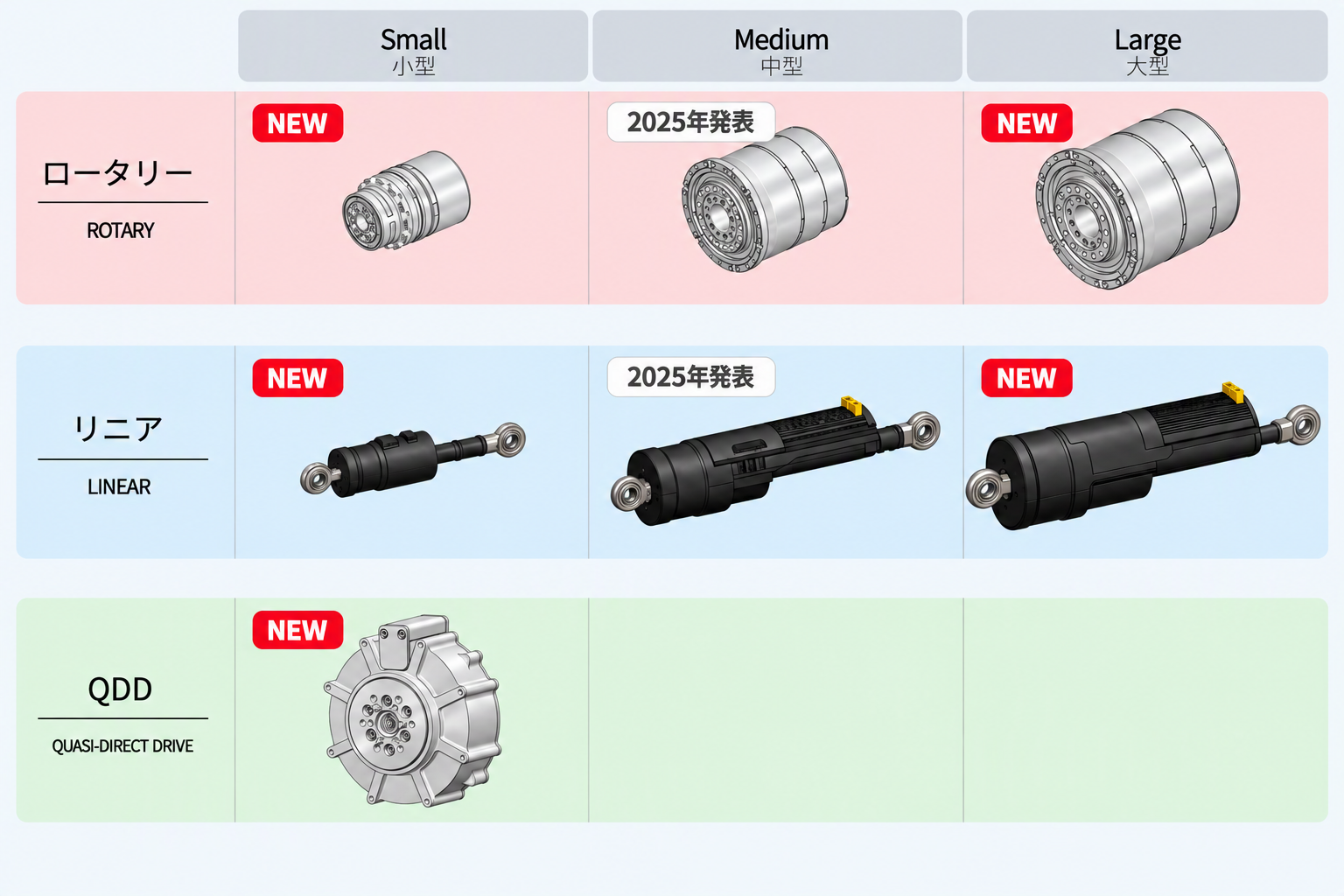
NSK adds small and large humanoid joint actuators and a new QDD actuator, aiming for market launch by FY2027
Bearing maker NSK says it has developed small and large sizes of its rotary and linear actuators for humanoid robots, adding to the medium size it announced in 2025, plus a new quasi-direct-drive (QDD) rotary actuator. The rotary units are meant for wrists and elbows (small), knees and shoulders (medium) and hips and waist (large); the linear units for forearms, upper arms and legs, and thighs. The QDD actuator uses "a low-reduction-ratio planetary gear mechanism" to combine high responsiveness with back-drivability, for wrists, elbows and the legs of quadruped robots. NSK will show them at RoboNext 2026 in Osaka (2–4 December), then start sampling, and aims to bring them to market by FY2027; it targets annual robot-business sales of 100 billion yen in FY2036. The release gives no torque, thrust or weight figures. For a robot builder it means a large bearing and ball-screw supplier now offers a joint-by-joint actuator range. Every figure is NSK's own. The source is in Japanese; quotes are our translation.
Every number is read from the public Atlas catalog. Where Atlas has no source, it says so instead of filling the gap.
Open a line to see where it comes from.
The mapThe whole public catalog, laid out by what connects it
Every dot at the top of the page is a public product, every ring its maker and every gold diamond an interface standard, joined by the ports Atlas has on record: 1,052 products in 59 categories and 1,118 product-to-interface links, read from the catalog on 29 November 2026. The positions come from a force layout Birdwave's server computes, at most once an hour, so the same catalog always draws the same map. It shows no images and no prices.
CountsThe public Atlas catalog, at most an hour old
Every number on this page, from products and makers to organisations, integrators, events and sourced specs, is read from the public Atlas catalog when the page is built, and the page is rebuilt at most once an hour. Nothing is typed in by hand.
Most stockedThe six shelves holding the most products
Ranked by how many public products each category holds, the same count the category browser at the top of the page shows. The chips use the plain word for each category; each opens that category's own page, which lists the same products.
Sources3,935 specs link the document they come from
A spec in Atlas carries a link to the maker's document it was read from wherever one is on record. The data standard lists every rule a record has to meet, each with its live number.
The flockBirdwave's Formation mark, drawn live
Many parts, one motion: a flock that settles into a robot arm over a belt, the gold birds landing last as the gripper and the part it holds. It is drawn on your device from no data, rests while it is off screen, and shows the formed arm straight away when your system asks for reduced motion.